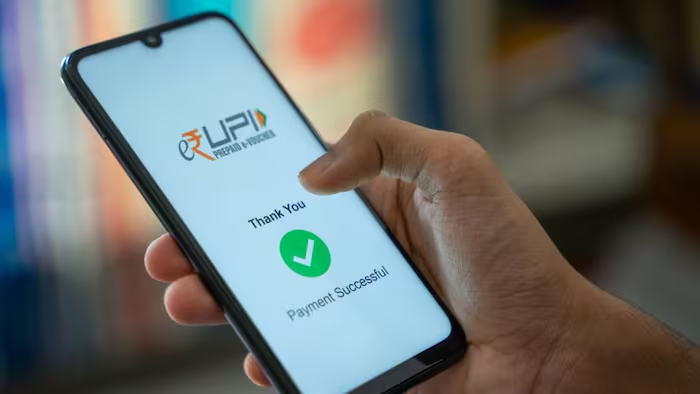
Concerns over whether Unified Payments Interface (UPI) transactions could soon become chargeable have surfaced after Parliament cleared a bill that allows the possibility of fees being levied on certain merchant transactions. However, the government has clarified that ordinary UPI users will continue to make payments without paying a transaction fee.
In a clarification, the Ministry of Finance said that customers will not be charged for making UPI payments. It also confirmed that all Person-to-Person (P2P) transactions will continue to remain free.

The proposed framework relates to the possibility of introducing a Merchant Discount Rate (MDR) for a limited category of merchant transactions. If introduced, the charge would apply only above a specified transaction threshold and would be levied at a nominal rate, the government said.
Reports have suggested that banks and payment service providers could eventually be permitted to impose an MDR of around 0.25% to 0.4% on certain UPI payments above ₹2,000 when the payment is made to a business. However, the government has stressed that such a charge would not apply to every UPI transaction.
Will everyday UPI payments become expensive?
For most people, routine UPI payments are expected to remain unaffected under the proposed framework.
Payments made for everyday purchases such as milk, vegetables, groceries and other small-value items, as well as payments to auto-rickshaws and taxi drivers, are not expected to attract an additional charge if they fall outside the proposed threshold and merchant categories.
The government said reports suggesting that ordinary users would have to start paying for UPI transactions have incorrectly interpreted the proposed changes to the Payment and Settlement Systems Act, 2007.
It stressed that the overwhelming majority of merchant transactions on UPI would continue to remain free.
How would MDR work?
Unlike a blanket fee on UPI transactions, any MDR introduced in the future would be threshold-based. This means the charge would apply only to specified merchant transactions crossing a particular value.
The proposed changes relate to Section 10A of the Payment and Settlement Systems Act. According to the government, the decision on whether MDR should actually be introduced would be taken by the UPI and Services Steering Committee, chaired by the National Payments Corporation of India (NPCI), after the relevant legislative process is completed.
The government has also indicated that any potential UPI MDR would be significantly lower than the charges traditionally associated with debit and credit card transactions.
Why is the government considering a fee?
UPI has experienced enormous growth in transaction volumes, creating a need for continued investment in cybersecurity, fraud prevention, technology and payment infrastructure.
The government has argued that the UPI ecosystem also needs to remain commercially sustainable as more banks and payment companies enter the market.
At present, the system relies significantly on government support to compensate payment ecosystem participants. According to the government, relying entirely on subsidies may not be sufficient to support UPI’s next phase of expansion.
The proposed approach is therefore aimed at creating a possible revenue mechanism without shifting the cost to ordinary users.
For now, the key message for UPI users is clear: there is no proposal to impose a general transaction fee on consumers, and P2P UPI payments will remain free.