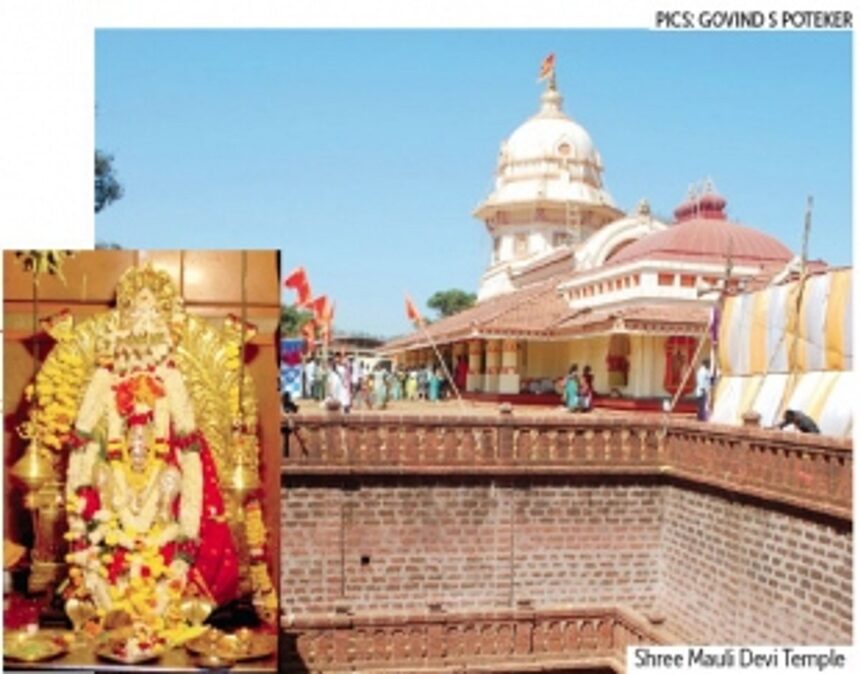
Meandering drive through one of nature’s biodiverse region, passing through thick forest leads one to Goa’s neighbouring village of Kankumbi. It comes under Khanapur taluka of Belgavi district in Karnataka. In recent times, it is making news for two reasons, Karnataka’s river diversion projects and divine presence. Short paces away from the highway, a long queue of devotees are lined up outside the precinct of Shree Mauli Devi (also known as Parvati- Ambadevi) Temple from early morning to offer prayers notwithstanding the hot sunny day. The pleasant weather of the Western Ghats suddenly made the difference as the humidity of day took over.
Home to some 5000 plus Konkani and Marathi speaking residents, this sleepy village situated close to Goa and Maharashtra border is abuzz with activity as the village comes to life once in 12 years as the villagers celebrate the grand feast of Shree Mauli Devi, the presiding deity of the village. This time festivity was celebrated two years later due to pandemic.
The village is replete with history and legends as the three states are historically connected by sister goddesses from Kodali, Gulamb and Kalasgade, Chandgad, (Maharashtra), Chigule, Gunji and Kapoli (Karnataka) and Parye and Zarme (Goa). All these deities visit the Tirtha Sthan when River Ganga and Bhagirathi make appearance once in 12 years fulfilling their promise to their beloved younger sister Shree Mauli Devi and brother, Shree Ravalnath (Kankumbi), as devotees believe.
The feast coincides with astronomical event as Guru (Jupiter), the largest planet in the Solar System enters the Capricorn constellation (Makar Rashi), which is considered as one of the most auspicious time as it is linked to happiness and prosperity. Devotees notice the astonishing sight about the rise in water level in the temple pools and the water turning milky in colour at the Tirtha Sthan.
The president of the temple, Adv Raghuvir Nagesh Dalvi (Baban), explains the evolution of the festival that is celebrated with great fanfare and gaiety. He says, “It is believed that when Nandi, Lord Shiva’s vehicle was roaming in the forest, he was fatally injured by a tiger, but before he breathe the last time, he wanted blessings from Shree Jagdamba Devi and other deities. They appeared and promised Nandi, that every 12 years they will visit this sacred place to remember him.”
Speaking about the festival Dalvi adds, “The temples were recently renovated keeping the original structure intact under the expert guidance of architect Kamalakar Dattaray Sadhale.” About eight lakhs devotees visited the shrine over a period of a week to be part of a giant congregation as the villagers welcomed a sea of devotees coming from far and wide. Dalvi says, “Despite limited resources, they worked overtime and romp in whatever little help they got from devotees, to make the festival something to remember for everyone.”
Devotees came from all the neighbouring villages from the state of Maharashtra and Goa and far-off places in total devotion to Devi who is considered to be benevolent to the devotees whenever they invoke her blessings to fulfill their vows. Narayan Vaman Pednekar who came from Sawantwadi along with his wife says, “Visit to the Zatra is a must for us every year, but this year it is a special occasion for all the people.” And, there was Laxmi and her daughter who came from neighbouring village of Keri, Sanjay and his family from Chandgad and thousands of others who came there to pay their obeisance to Devi.
Surrounded by nature’s bounty, some hundred meters away stands the ancient temple of Shree Rameshwar from where the rivers originates. Very little is known about when these temples were established, but available information and similar style of architecture shows some resemblance to temples in Goa and Konkan region. It is believed that Mauli Devi Devasthan is one of the oldest temples that probably must have been built in the 12th century.
Historian Rajendra Kerkar enlightens on the history of the temple. “Our belief comes from folk tradition” he says. “Shree Mauli Devi is presiding deity of Maulichi Rai in Vagheri hill, Keri, Sattari. This sacred grove was once known for varieties of spices. It is believed that the goddess used to visit neighbouring places during night to keep watch on subjects and would return back before dawn. During one of her sojourn, she couldn’t come back, but remained in Kankumbi that lead the villagers to install her temple in their village.” he adds. The temple is basically built with laterite stones. The Sanctum Sactorum is in Chaitya style and overall the architecture resembles Rashtrakuta mode as observed in Kolhapur, confides Kerkar.
One of the most unique features of this place is the evolution of riverine system. This place is not only of religious and historical importance, but has a unique geological significance too as one river and tributary of another originates here.
Origin of River Malaprabha that flows into the Bay of Bengal and Kalsa, the tributary of River Mhadei or Mandovi flowing into Arabian Sea has bestowed this place a sacred space in the minds of villagers. The rivers have common origin.
People consider this place as an abode of seers. It is believed that there once lived a seer named Kulak, a disciple of Lord Shiva. He started a Gurukul, where he imparted knowledge of religion and spirituality in young students. For his dedication, Lord Shankar presented the seer with Shivling which is installed in the Shree Rameshwar Temple and a Kalash (pot containing water). Originally the place was known as Kulkabi in honour of the seer Kulak, which later became Kankumbi. The tributary of River Mhadei, came to be called Kalsa from the Kalash. The rivers spring up in the mountain and enter the Shree Rameshwar Temple pool by subsurface mode where it bifurcates into two streams. The Kalsa tributary joins River Mhadei and Malaprabha flows into the bathing pool of Shree Mauli Devi temple and further the water reaches the Tirtha Sthan, also known as Konkan Kashi, which was once considered as the most famous place for religious rites.
It is noteworthy to mention the efforts of the temple committee who put up a massive work to make the festivity a grand success. They made arrangement to serve varieties of delicacies for lakhs of devotees. Cooked in large vessels, the local hands teamed up with professional cooks from Belgaum to put enough food on the platter. The village folks didn’t lack in hygiene by keeping the place tidy and clean by clearing the trash regularly before the next serving.
Even as the beliefs in people got stronger and renewed every 12 years as gods converged to bless the devotees at the Tirtha Sthan, the people in Goa will be hoping Shree Mauli Devi and Lord Shankar’s blessings remains with the people with Kalsa and other tributaries flowing freely till eternity.