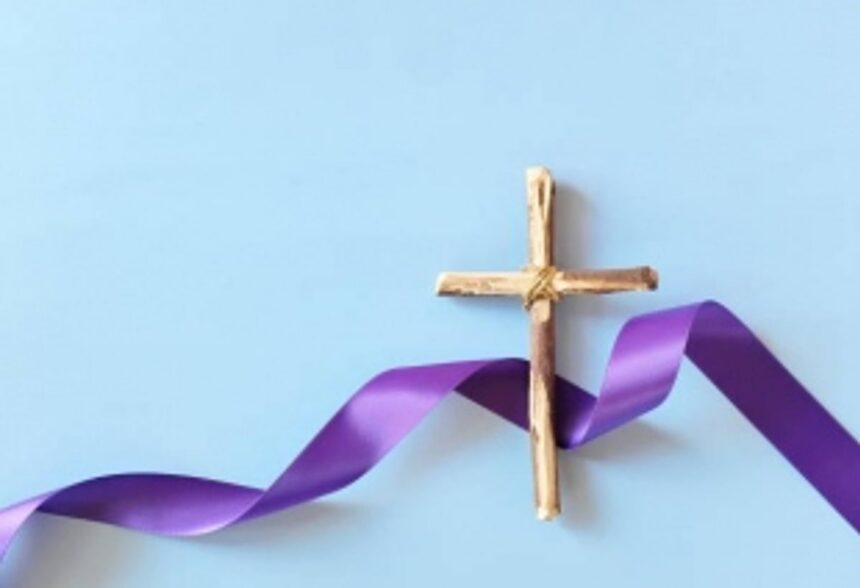
The liturgical seasons of the Church help the faithful to seek the Kingdom of God. Recently, with the ashes on the forehead, the Church have begun another season, a season to dress the cross and make it beautiful and colourful. It may even capture or move one’s heart.
Dressing the cross! The question that comes to mind is how can it be done? With flowers? What types of flowers or decorations or with what accessories? The word ‘Cross’ usually doesn’t sound good albeit one cannot deny it. Cross is not just a physical structure but the invisible ones that one experience and are laden with and are a part and parcel of life. A cross in one’s life means something that is a burden to carry, a block to proceed, a nuisance that irritates, an unnoticed compulsion. Something, that which disturbs the conscience and takes away the innocence of the purity of thoughts, mind and the whole being.
There are people who feel depressed all the time because of a sense of guilt. Doctors are discovering that many psychosomatic sicknesses are caused by guilt and condemnation because the conscience is saying, “You have done wrong. You must be punished. How can your sin not be punished?” Therefore, the next time one’s conscience condemns you, look to the cross and say, “Father, thank you for Jesus and the Cross. Jesus was totally condemned on my behalf, so there is now absolutely no condemnation left for me.”
The conscience plays an important role in one’s life. It’s like the iron (bar) or an iron (rod). The iron is easily prone to dust and din. Unless it’s covered with the chemical, it soon gets rusted. And so is one’s conscience. One often hears people saying, does he have a conscience. In Konkani, it is said, ‘Tannem konsience bazun khailam.’ Consequently, the season of Lent is a time for introspection, a time to touch the core of one’s being, that is the conscience and thus, glance into those areas which take away joy, peace and goodness.
For, the fallen condition of humankind was made good with the sacrifice of Jesus Christ upon the cross. He restored His image in the heart of man as the one redeemed by Christ. Picture a potter shaping a formless lump of clay into a useful vessel. In that process of moulding, the clay falls apart, no longer reflecting the potter’s design. Yet instead of discarding it, the potter flattens it out and begins anew. So also, the Heavenly Father is shaping every believer into ‘the glory of Christ, who is the image of God.’ God transforms the corrupted conscience of fallen man into the image of Christ (Col 3:9-10).
Urged by the love of Christ and the clarion call of the Church to repent and come back to God like the prodigal son, the Lord asks Prophet Isaiah to tell the people in chapter 1: 16, saying, ‘Wash yourselves; make yourselves clean; remove the evil of your doings from before my eyes; cease to do evil, learn to do good; seek justice, rescue the oppressed, defend the orphan, plead for the widow.’ Because the essentials of the Lent season: prayer, fasting and alms giving is easily done. It must be something that hurts; something that counts. What Judah needed was not to continue to multiply sacrifices, prayers, etc., but a new heart which would be the source of new attitudes and new actions that truly honour God. To look within the core of the being – the conscience – and eventually to form it.
In the light of current happenings, it is also the Lord saying to take up these crosses (issues) too besides one’s own cross and dress His Cross with the words of prophet Micah, 6: 8 ‘What does the Lord require of you? But to do justice, and to love kindness, and to walk humbly with your God?’ To love justice and purity is far more acceptable to God, than thousands of donations and other charities.