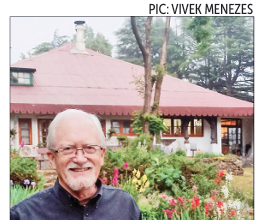
“When colours come in contact with the canvas, the artist becomes silent and the moment is lived,”
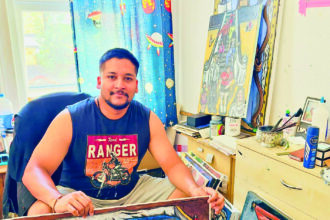
says Dr Kapadi, A dentist, artist, poet, social worker, who is holding an
exhibition of his works, titled ‘Paint-O-Poetry’, in honour of late Adv Satish
Sonak. Dr Guruprasad Krishna Kapadi, a dentist surgeon by profession, believes
in taking pride in one’s talent rather than suppressing it in order to pursue
one’s profession, taking pride in his love for art and poetry. He creatively
opened his mind to his passion when he was in his late 40s, a journey that took
him along the path of art as well as social work.
Being a social worker to help those in need was a goal that was
achieved by Dr Kapadi. He has initiated several projects to help the
differently abled and the less affluent and played a pivotal role in setting up
Keshav Seva Sadhana School for Special Children at Bicholim. And effective and
heart-warming way in which has reached out to the needy is by using his own
hobby of art and poetry to raise funds. The funds are generated through solo
art exhibitions conducted by him.

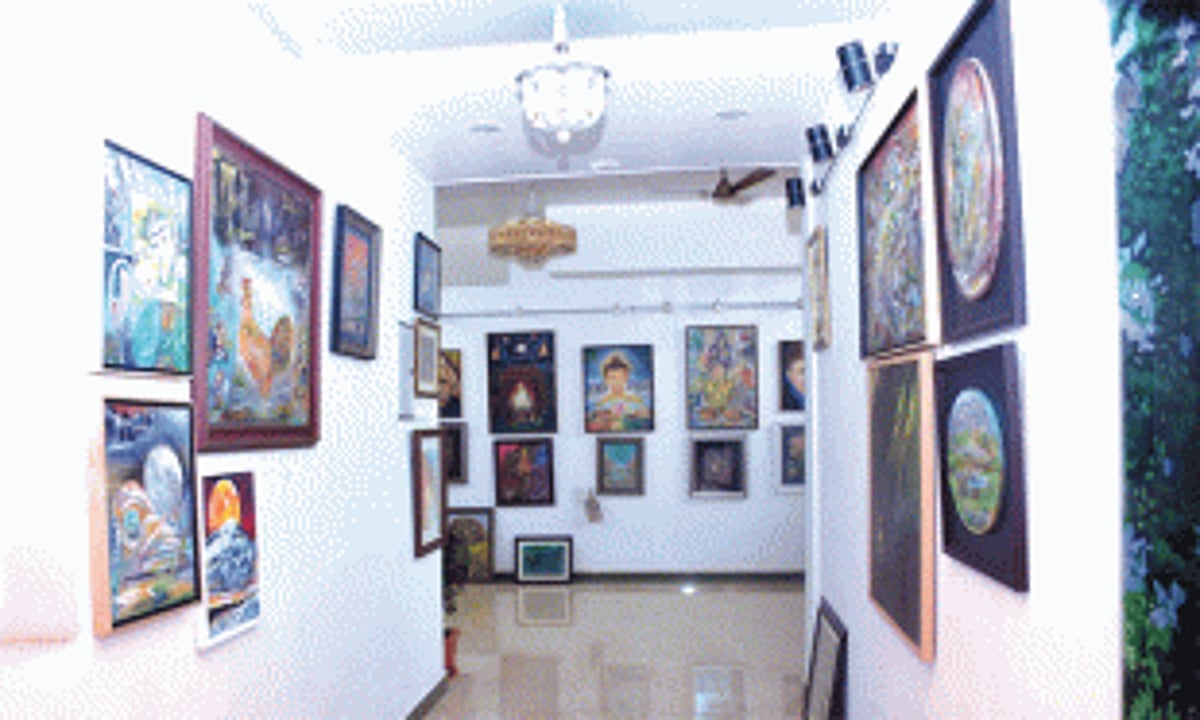
Similarly, on January 5, 6, 2019, he will be conducting an
exhibition of his paintings, titled, ‘Paint-o-Poetry’ at Kala Academy. Dr
Kapadi’s most recent works will be showcased there. The painting exhibition has
been organised to support the cause of the differently abled. ‘Paint-o-Poetry’
also pays tribute to late Adv Satish Sonak, a fearless crusader who firmly
contributed truth to the society with his uniform writings. He enrolled in
social work by taking charge of objectives of the transgender, and disabled
people. Dr Kapadi recounts how late Mr Sonak stood as a pillar, aiding the
Vanarmare tribe. “We remember him as a man who helped others and made their
troubles his own,” says Dr Kapadi.
He believes that his interest in art flows in his blood. “I’ve
always had a passion for art and music. My father was a professional artist; in
my young days, I was inspired by my father’s paintings.” Now that he has
developed his craft, Dr Kapadi has learnt to divide his time between work, art
and social service.
It was an honour for Dr Kapadi when he had the opportunity to
give a piece of his art to the late Dr APJ Abdul Kalam (the then President of
India). Currently, most of his paintings are exhibited at Nirmalya, his
yet-to-be-inaugurated art gallery in Bicholim.
Painting is always known as the most creative visual art that
can describe a million words and Dr Kapadi keenly expresses himself through his
art. For him painting is a solidification of medication in known form where the
colours, brush and canvas are silent. The stroke of brush when the colours come
in contact with canvas is a form of harmony that brings out the artist’s
thoughts and emotions. “The artist becomes silent, the moment is lived,” he
asserts.
Similarly, when it comes to penning down words, poetry, for him,
is a language that starts as a feeling and grows into a thought, which then
grows louder into words that are written down to let another individual relate
to their own story. “Human life is poetry to me,” Dr Kapadi expresses,
enfolding his experience with poetry as a flow and rhythm with diverse colours
and shades.
Apart from his regular art exhibitions, Dr Kapadi has his own
song album CD that contains eight songs that have been composed by him, with
music by Ashok Patki and vocals by renowned artistes from Mumbai. Twenty-five
per cent of the income was given to Keshav Seva Sadhana School.
The initiative behind Paint-O-Poetry is a humble effort to have
an ultimate point of contact and Dr Kapadi looks forward to a positive outcome
that will address the needs of the deprived.
He
concludes that the present generation should sensitise their minds towards
issues of others and make this society a beautiful place to dwell in harmony.