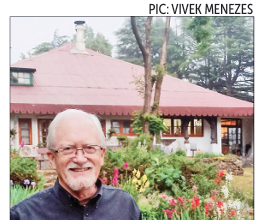
Fighting the good
fight for the environment as a Greenpeace team member in Bangalore, Samir
Nazareth quit the organisation in 2004 to make his own discoveries about
nature. “After I quit, I came up with the idea of travelling,” shares Samir of
his journey in February 2005 that took him from the northwest tip of the Indian
coast (Rann of Kutch) down the west coast of India and up the east coast to
Nathula in the eastern Himalayas six months later. The choice of the route was
perhaps preconceived for its cooler climes and scenic and safe locales, but
other than that, Samir confesses to undertaking the journey with no
predetermined notion of time or place, but just an ‘open to all experiences’
attitude.
It’s an attitude that
served him well. “The crux of the journey was to meet people, understand their
ideas and share ideas. I would just walk into a town and stop for a chai or be
stopped and get into a conversation. I was extremely open to speaking to people
and understanding their ideas,” avers this Nagpur based Goan who backpacked his
way through the entire route, travelling by state transport and resting at
cheap digs. “I literally visited 76 small towns en-route, some of which are
barely heard of, stopping for a few hours or some times for a few days at each
place. As for the 1,400 bananas, they were my main sustenance on a shoestring
budget and a six-month route. I had one big meal a day and subsisted on bananas
which are incidentally very nutritious and safe,” he explains of the three
aspects that lent themselves to the title of his book.

However, the idea of a
book did not even arise till Samir was halfway through his journey. “I kept a
journal of things I saw, people I spoke to and things I did. It was a factual
day-to-day account of people, incidents and my views of things I saw on the
journey. But I slowly began to realise that the people I encountered had
extremely interesting points of view – whether it was the Indo-Pak border issue
or my unmarried status and I thought this would make for an interesting read,”
explains Samir, whose post graduation in developmental economics and later
clinical psychology helped to shape his perspective on the travelogue.
Travelling the
unbeaten path, his book, he maintains, is not about known places. “Rather, it’s
about how people see history and how the people in these places live. It’s a
peek into parts of India that not many know of or have heard about. For
instance, I spoke to lot of fisherman at Mandir (Gujarat) – the famed place
where dhows are built. The dhows are captained by crews who are residents of
this place. They all begin as deck-hands and slowly learn to navigate,” Samir
elucidates. But more than a factual recounting of these stories, Samir firmly
believes that these people need a forum to share their views and stories. His
online and hardcover book, which took six years to publish, is a tribute to the
extremely friendly and forthright residents he encountered en-route.
(Samir Nazareth’s book
‘1400 Bananas, 76 Towns and 1 Million People’ will be launched at Cafe Literati
at Calangute on March 14, at 6.30pm. Samir will be in conversation with
Anniruddha Sen Gupta and Aditi)