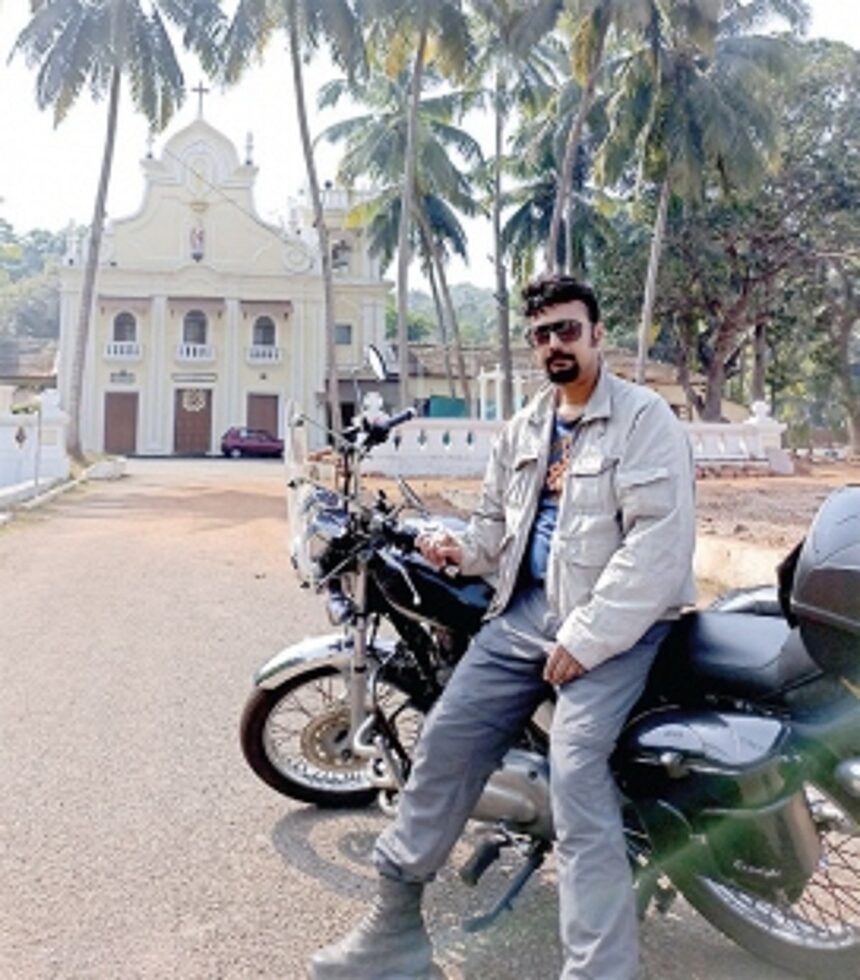
Sun tan, fatigue and homesickness, these words don’t exist
in Lueit Hazarika’s dictionary. With his positive attitude and his curiosity to
learn more about the people of India, he set off on a journey exploring the
roads less travelled and on a ride he calls the Soul Searching Trip. He set off
on December 7 from his hometown Guwahati, Assam and he reached Goa on January
24. With just the bare minimum load on his Royal Enfield Thunderbird, he is
travelling with an open mind and spontaneity.
According to the Ministry of External Affairs, the total
length of the coastline of the mainland, Lakshadweep Islands and Andaman and
Nicobar Islands is 7,516.6 kilometres. When Lueit was travelling from Andaman
and Nicobar Islands back to Guwahati by flight, he noticed the beautiful coast
of the country from his window. “The journey was mostly over the coast of the
country and I thought how beautiful it will be travel on the coast from the
East to the West of the country. This was back in 2019. Finally, I planned the
trip almost six months back and 50 days through the journey, I am in Goa,” says
Lueit Hazarika, who is also known as Luei Zara, when he explores his passion
for music.
A well-known architect in Guwahati, Lueit runs his firm
along with his wife of 20 years, Neha Kaul. On the journey too, he sometimes
take a day’s break to complete his work, while enjoying the sounds of the
crashing waves. “Neha is a huge support for me as she is my wife and my
colleague. We call each other throughout the day and as she is handling the
company on her own, she does need my help sometimes to compete the projects.
Our 13 year old daughter Nirvana is excited about my trip and wanted to join me
on his journey,” says Lueit.
Travelling through the states of Assam, West Bengal, Orissa,
Andhra Pradesh, Tamil Nadu, Kerala, Karnataka and Goa, he has avoided the
highways and taken the routes closest to the beaches in these states. “These roads
are difficult but extremely beautiful and my journey was to spend the most time
with the people living on the coast and I realised that their lives are more
challenging as they are close to natural forces and though they have the basic
amenities, these places can be very different from the city life. They have a
difficult life but a broader mind and a bigger heart, just like the ocean,” he
explains.
Going with the flow, his days are not planned according to
an itinerary. He travels whenever he feels and if he finds something
interesting, he goes inwards towards the mainland before heading back to the
coast. “When I reached Chemperi in Kerala, I heard about a temple that
celebrated the Theyyam festival. This is a private temple ritual and this
particular Theyyam is being performed for a week at a family temple after a gap
of 80 years to revive the temple, as many from the family were dying of
unnatural causes. It was a great experience,” adds the singer, songwriter and
composer. He prefers not to read about the places that he will be visiting next
as he likes the locals to share their knowledge and he does make great friends
quickly, even if they don’t speak the same language.
His diet on the road is very simple. He loves to savour the
local cuisine and finds the variations in the same dishes very subtle. He says,
“I eat where the locals eat and they eat very simple food, dal, rice and a
vegetable dish is the basic dishes. When I reached West Bengal, the dal had
mustard and chillies added to it. As I travelled south in Orissa, there were
more vegetables added to the dal which they call ‘Dalma’. In Andhra Pradesh,
the dal turns more sour and closer to the taste of Sambhar. In Tamil Nadu, the
Sambar is served and as you move to Kerala, the dal gets a bit diluted and then
Karnataka, it is back to the same dal that we are usually used to eating. The
food is served at a nominal cost.”
Moving on the bike, he is closer to the people. He
experienced rain on the border of Andhra Pradesh and Tamil Nadu but his bike
broke down once in an interior area in Tamil Nadu. Fortunately, help did come
in many ways and he says he was lucky to be on the road soon. But his bike is
the happiest here in Goa, because the bike received the most parts and repairs
that Lueit didn’t find in the other parts of the country. “I realised that
bikes are the lifeline of Indians. You will be amazed to see what can be
carried on bikes. I have even seen people carry a door frame. Since my bike is
a 2006 model, it is difficult to get parts for it as they have stopped
producing parts. I finally got almost everything for the bike at the workshop
in Margao and now my bike is very happy and it is singing happy songs. I stayed
back to try the bike for a day or two before I head to Maharashtra,” he adds.
Lueit also prefers to stay in the homes of locals whenever
possible and often finds friends and friends of friends who are happy to help.
However, he did find difficulty as a single man to get accommodation. “As an
architect, I wanted to stay with the locals and see their designs. I stayed
with fishermen and even Adivasis to study how they are living. In Bakkhali,
they don’t let rooms to singe men for the reason that they commit suicide in
the room. A security guard let me stay with him in an under construction
building. I had the same experience in Digha, where they put a staff member as
a second guest with me for the booking. In Kanyakumari, it was the same but one
kilometre away, you can find accommodation,” shares Lueit.
With so many interactions and great memories, Lueit is
constantly penning down his experiences on his diaries as well as his Facebook
account by sharing his daily posts. Loaded with photographs to go with his
post, his documentation is really informative and makes the readers feel like
they are on the journey with him. One aspect he has learnt on the journey is
not to fear. “In the beginning, there was a small sense of uncertainty and fear
makes it further complicated. This fear can be sensed by the other person too.
I now go with an open mind and I made great friends along the way,” concludes
Lueit.