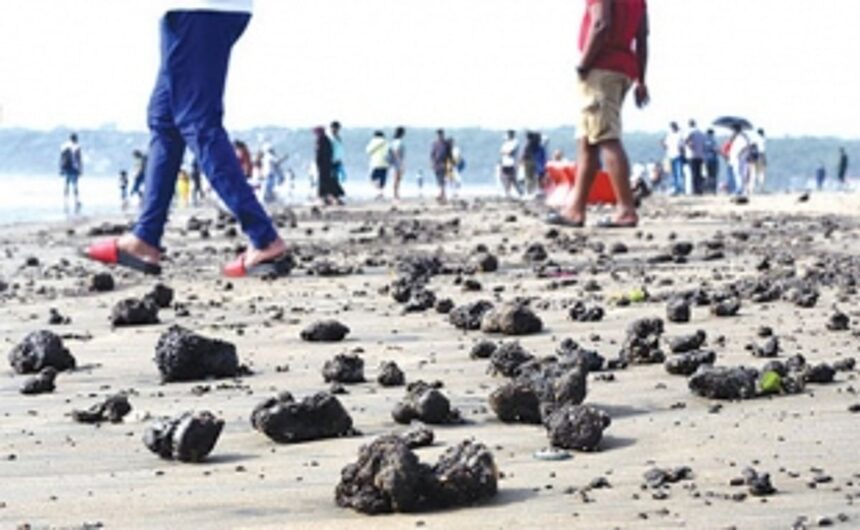
Riddled with black muck, Goan beaches are suffering with an
invasion of tar balls washing up on the shores during the onset of the monsoon
season. Along with the threat to wildlife, tourism, Goa’s major source of
income, also faces a fluctuation in visitors. Every year oily hazardous tar
balls cause major damage to Goa’s beaches, which is the main attraction for
tourists coming here.
As the murky sludge continues to plague
our precious Goen and its pristine beaches, the youth of Goa feel that the government
must take concerete steps to protect the beaches from the tar balls. While the
concerned departments are working hard to control this problem, but more has to
be done since these beaches attract lots of tourists, who are the lifeline of
State’s economy.
As such this may not have much of an
impact on tourism as the seasons ends before monsoon appraoches, still it gives
an ugly appearance to the beaches of Goa. Faheem Killedar, a student from
Dnyanprassarak Mandal’s College, Mapusa said, “Since Goa is almost entirely
dependent on the tourism industry, the State’s beautiful image certainly takes
a hit. It is obvious that tourists will spread their experience of Goa through
social media and various other platforms, which will in turn decrease the number
of tourists wanting to vacation here resulting in decline in revenue for the
State.”
“Besides being a tourist attraction, beaches play an important
role in our ecosystem. They act as a buffer, protecting us to a certain extent
from storms and other extreme weather. This helps protect residents and
property near beach areas.” says Nehara Pandey, a marine biology student.
She also informed about how this tar washing up on our shores
could affect the marine life inhabiting these waters.
“Beaches also play an important role in the lives of many marine
organisms. For example, turtles that nest on Goa’s beaches. With changing
weather patterns due to the climate crisis and the loss or destruction of
habitats of many marine organisms, it is of paramount importance that Goa
protects its beaches not only as a tourist attraction but also to protect its
beautiful natural habitats and the organisms it supports.”
As the young generation firmly believes in saving the
environment, they feel hurt that Goa’s beaches are getting polluted due to
human negligence.
Diksha Gawas, a mass communication student from Don Bosco
College, Panjim lamented, “Who doesn’t love beaches? My relatives have a house
beside the sea and whenever I get time I go there, it’s peaceful there. But it
hurts me to see the pollution swamping our beaches. The tar balls float and
come to the seashore, and as I have studied about it, it’s very harmful to
aquatic life and this makes me sad. The only solution is to clean the tar balls
from the our beaches.”
As the State Government undoubtedly prioritises the tourism
industry, the youth suspect that the environmental aspect of it has not been
given much importance even tourists flock to the State. “I believe that we as a
community should come together to help clean the coast of Goa.”
Aviral Gurung firmly states as his family runs tourism-dependent
fast-food joint in Saligao where visitors stop on their way to Calangute beach.
The 16-year-old calisthenics trainer feels strongly towards the injustice to
our environment and explains that tar balls occur when oil slowly escapes from
the earth’s surface which are generally caused by oil spills.
“In Goa, tar balls are formed due to the oil that spills from
passing sea vessels, which then react with saline water and get deposited into
the sea,” Gurung said.
The youngsters also feel that they can play an important role in
preserving the State’s environment by spreading scientific knowledge in the
community.
Faheem Killedar elucidated, “I know that tourism and the environment
are extremely important for us Goan locals. We (students) have been constantly
trying to find solutions for different problems all year round. This issue is
not new and the authorities are still yet to resolve it but, we must remain
focused on saving the environment.”
He further assuredly said, “I think if we can put pressure on
the authorities through various social media campaigns, we will definitely see
some change.”
Our youth have shown us that technology has advanced to such an
extent that it can be used as an aid, if not a weapon, to turn tides for the
better.
As
one can’t wish away either tourism or environment, the youngsters hope that
they could eventually manage to ensure that economy and ecology flourish
together.