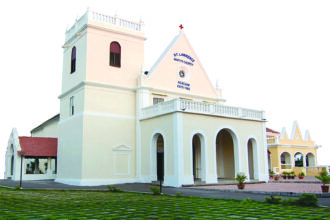
Standing tall and elegant in the heart of the
capital is the famous Church of Our Lady of Immaculate Conception of Panjim
(Igreja Maria Immaculada Conceicao). With a flight of steps adding to the
exquisite charm and majestic look of the immaculate and white façade, the
Panjim Church is rooted in Goa’s historic past for more than four and half
centuries. Built originally before 1540, i.e. between 1510 and 1540 by the
Portuguese, the Shrine of Nossa Senhora da Immaculada Concecao was raised to a
Parish Church in 1600. It is one of the oldest Catholic ecclesiastical
structures of Panjim; contemporary to the Cabo Chapel at Dona Paula. It was
rebuilt from its foundations in 1612 but historian-scholar from Panjim Antonio
de Menezes writes that it was rebuilt in 1619. (‘Goa’– Historical Notes – Vol.
I by Antonio de Menezes) He further states that the flight of steps which leads
up to the Church dates back to 1870.
The bell at the top of the Church is the second
largest in Goa, the first being that of Se Cathedral at Old Goa. The Church,
which was originally a chapel, stood on a small hillock called ‘Concecao Hill’
and hence the necessity was felt to build the majestic steps. The bell was cast
in 1749.

It was in this Church that in the year 1619, the
Portuguese Governor of Goa, Ferrao Albuquerque, took charge of his office. It
was in the same Church, on September 8, 1641, that the royal proclamation of
Dom Joao IV (Braganca royal family) as the 21st King of Portugal was read out
by a nine year old boy named Andre, writes Antonio Menezes and C M Estibeiro.
Estibeiro, in his book ‘Goa, Yesterday & Today’, writes that the Church of
Mary Immaculate Conception has its own pristine historic splendour, apart from
the architectural beauty of its majestic façade with two balustraded towers and
one imposing central gable which holds the famous bell whose sound stills
strongly resounds throughout Panjim.
The majestic stairway of the Church set in a
zig–zag pattern rising in angled platforms has at the centre a beautiful pulpit
with the image of Our Lady in standing position raised on a pedestal with an
inscription of 8th December, 1954. The stairway has a balustrade pattern dotted
with posts. The façade has other architectural features like pediments, a Roman
arched entrance, pilasters, niches, belfry and above all, a red cross set on
the King’s crown at the apex of this charming Church. Its illuminated view is a
visual feast to the eyes. During the Portuguese period, the Church was located
near the St Thomas Aquinas College.
Antonio Menezes mentions that it was one of the
six shrines mentioned in the Covencao of June 30, 1541, the others being the
shrines of Cabo, Carambolim, Batim, Diwar and Banastarim. The altar of the Church
is in the baroque-Renaissance style. The side altars are that of Mother Mary
with Jesus lying on her lap; another altar is dedicated to St Francis Xavier.
There are many Portuguese inscriptions of 1866,
1871, 1955 etc In the Church. According to one inscription in Portuguese in one
corner of the Church, Governor Senhor Don Luis Caetano de Almeida ordered the
sails of the baptismal font in which he was baptised in the year 1708 and they
were executed in the year 1742.
December 8 is the Feast Day of the Church which is
celebrated in a grand way since the Portuguese time.