Dolcy D’Cruz
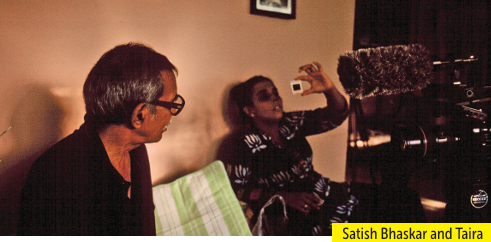
What goes on in the mind of a conservationist that makes him leave home and live closer to the ocean? Goa-based filmmaker Taira Malaney’s documentary film ‘Turtle Walker’ centres on Satish Bhaskar, a pioneering Indian herpetologist who, beginning in the late 1970s, undertook an extraordinary journey along India’s coastlines and remote islands to study sea turtles. Dropping out of college in Chennai at a young age, Satish chose an unconventional life, marooning himself for months at a time on isolated beaches and islands to observe turtles at nesting sites that were then largely undocumented. His work helped identify and map crucial nesting habitats across India and laid the scientific foundation for modern sea turtle conservation in the country. Taira’s own journey to this story was deeply personal. She did not formally study film. “I actually studied psychology in the US. My focus was on developmental psychology. I was teaching at Chidiyatapu in the Andaman and Nicobar Islands, helping to set up like a program for young children about marine conservation. I started taking pictures, and also making short films. I realised that film was a very powerful tool when you want to create some sort of change or impact. If it’s a really emotional story, and people resonate with the characters in it, it can really change how they feel about something,” she explains. Now based in Siolim and living in Goa for over 14 years, Taira’s connection to the sea deepened through lived experience. “I live near the sea and I’ve gotten to see turtles stranded on the beach, or hatchlings coming out of the sand,” she says. That closeness led her to search for ocean-related stories in India, a search that culminated in a chance discovery. “I came across this article written by Romulus Whittaker, and he talked about these stories about Satish that used to get passed on like legends in the sea turtle community. It just made me feel like what makes this person do this? To maroon himself on islands and live alone with turtles,” she recalls. Through marine biologist Dr Kartik Shankar, one of Satish’s mentees, Taira learned that Satish lived just an hour away in Colva. What followed was a six-year filming process marked by patience and trust. “Every couple of weeks, we’d go there and film with them at their home,” she says. Though Satish maintained meticulous diaries from every survey he conducted, he was initially reluctant to share them. “He was a private, reclusive person, and I respected that,” Taira notes. Years later, he unexpectedly invited the crew into his study and began reading aloud from his journals, a moment that became central to the film. The documentary also explores Satish’s withdrawal from active conservation after developing neuralgia, a condition that forced him to stop fieldwork. Yet the film reveals his quiet hope that the next generation would carry the work forward. With more than 70 screenings worldwide and an ongoing India tour, ‘Turtle Walker’ has already made a significant impact. Backed by Zoya Akhtar and Reema Kagti, ‘Turtle Walker’ has travelled extensively since its world premiere at DOC NYC, with screenings at the Raindance Film Festival, the Hamptons International Film Festival and a special showcase at the United Nations Ocean Conference. It has received major international recognition, including Best Film at AFO, the Conservation Award at the International Ocean Film Festival, and two of the highest honours at the Jackson Wild Media Awards, the Conservation Award and the prestigious Grand Teton Award. For Taira, it is only the beginning. Her next project, she says, will explore people’s relationships with wildlife in the Himalayan region, focusing on indigenous communities and women. (The 75-minute documentary, ‘Turtle Walker’ will be screened today, January 15 at 6:30 pm at Maquinez Palace, Panjim, followed by a Q&A with Taira Malaney.)