If you’ve grown up in a Goan family, you are no stranger
to Konkani proverbs as every life’s lesson can be eloquently
expressed in these sharp one-liners. Interestingly, the usage of
these proverbs continue till date. So it’s no surprise to hear your
mother scolding you in a single line when you miss your bus to
work by saying, ‘Vetek chukta to vavank chukta, vavank chukta to
ganvank chukta’ (He who misses a palm’s span misses a fathom,
he who misses a fathom, misses a league).
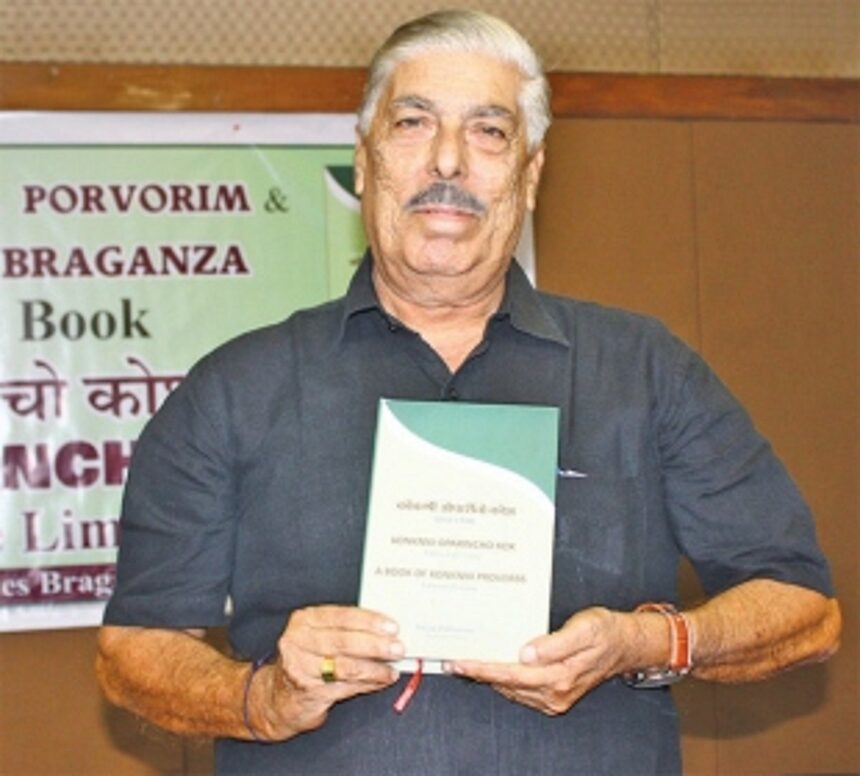
Dr Edward De Lima loves Konkani and his latest offering to the
language is his new book, ‘Konknni Oparincho Kox’ – A book of
Konknni Proverbs. Dr de Lima was a professor of English Literature,
Communication Skills and Business Communication at D M
College of Arts, Science and Commerce, Assagao for 35 years. As
an author, he has previously written three books, ‘Spoken Konkani
– a Self Learning Guide in the Roman Script’, ‘Konkani made Easy in
Devanagari’ and ‘Influence of Portuguese Vocabulary on Konkani
Language’.
“The use of the proverbs was basically to correct social
behaviour and to indicate a life of hard work, prudence, honesty
and well-being. As most proverbs were used by older people, they
manifest the rich experiences of their lives,” explains Dr de Lima
about the usage of proverbs in daily life.
The book is a compilation of Konkani proverbs both in Nagari
and Roman scripts and contains explanations and interpretations
in Konkani and equivalent proverbs in English
and other languages. “This book contains a
collection of over five years. The proverbs
featured are those which I heard from my grandparents in my
childhood and some which I heard over the years. I was fortunate
to have Konkani-speaking grandparents from whom I learnt to
speak fluently in Konkani in the Bardeshi dialect. For the book, I
have maintained the original dialects of Konkani from different
regions of Goa as the dialects change every few kilometres. The
book has proverbs in the dialects of Pedne, Bardez, Ponda, Salcete
and Canacona as well as those from Mangalore, Karwar and
Kerala,” he says. Konkani is found in Kerala as many of the Goud
Saraswat families from Goa settled in Travancore (Kerala) some five
or six hundred years ago,” he reveals.
The book has been edited by Rev Fr Mousinho de Ataide,
parish priest of Neura Church, and each proverb has been written
in Romi and Nagari Konkani to make it accessible to both readers.
“It was difficult to find a typist who knew both Romi and Nagari
Konkani and after quite a search, I met my ex student, Sudesh
Arlekar, who is the proprietor of Jagar Prakashan; Sudesh typed
the manuscript. I wanted the book to reach out to both sections of
readers as they are proverbs which are featured in society,” he says.
He further adds, “The people of yore were very
knowledgeable. They didn’t speak much but they could
summarise what they wanted to say in one meaningful sentence.
These proverbs have an influence from Jainism, Buddhism and
later the Bible. Some proverbs are ambiguous in meaning and can
have a double meaning or can be interpreted differently. For some
proverbs, I have given the English translation. The book features
over 2,000 proverbs and I hope it can be preserved for future
generations.”
Dr de Lima has put in a lot of effort, going through various
books to find proverbs of different dialects and compiling them
into a single book. “None of these proverbs are new and they have
been used by our forefathers and passed down from generation
to generation. Back then, children could speak Konkani fluently
and they lived with their grandparents and interacted with the
neighbours. The children of today are now living in flats in gated
communities and most of them don’t speak fluent Konkani.
Through this book, I hope parents can start using few of these
proverbs in their daily lives,” advises Dr de Lima.
The book has been published by Vikram Publications and
is available at Singbal Book House, Panjim and Golden Heart
Emporium, Margao