A large chunk
of the Goan way of life involves music. It’s a part of the joie-de-vivre of the land, and
children, irrespective of background, are enrolled from an early age to study
the art form. Prior to then Finance Minister Manmohan Singh’s 1991 Budget,
which opened the door to foreign investment, many instruments were made locally
(many still are) and sold at lower prices than their international
counterparts, which were often carried across borders by travelling friends,
relatives and fellow musicians. To date, these cheaper instruments are a viable
option for parents who are investing in their children’s musical education for
the first time. Others, the more seasoned musical veterans, opt for more
upmarket gear, which serves as the ‘tools of the trade’.
However, the newly
implemented Goods and Services Tax (GST), has hit the music community rather
badly, with 28 per cent being the amount that is being marked up as GST. There
is quite a bit of confusion amongst the community as to what the 28 per cent
GST on musical instruments applies to, largely down to an issue with the
classification of instruments. For instance, under GST, handcrafted indigenous
musical instruments are exempt from tax. Guitars and violins, however, even if
they have been manufactured in India, fall under the gambit of western
instruments, and are taxed accordingly. Does this possibly imply that many
parents, especially those from a lower income bracket, may particularly feel
the pinch and see the cost as a deterrent to sending their children out into
the musical world?

Founded in 1928,
Pedro Fernandes and Co. is a music store that is a testament to the sheer
quality of music-related establishments in the state. From the common
instruments used on a day-to-day basis, such as guitars, keyboards, and
violins, to the more obscure items that leave the store, such as the digeridoo,
darbuka and Vietnamese morchang, it serves as a complete one-stop
shop. Ashly Fernandes, of the family-run store, states his view on the effects
of GST for his clients, saying, “At the moment, there is no immediate effect
for the end consumer. As dealers, we’ve taken the hit, to an extent, but in
order to keep the business flow, for now, we are okay with that absorption. The
government has promised rebates, but we will see, over the due course, how that
plays out.”
Another dealer, who
preferred to remain unnamed, stated, “My sales have reduced by approximately 30
per cent since the introduction of GST. With reduced margins for retailers,
it’s becoming tough for us to offer discounts to customers.”
Lenon Pires, a music
teacher and musician himself, ads his point of view to the matter, saying,
“It’s hard to make a living as musicians, and if there is an increase in the
cost of gear, it won’t be appealing to those who have to spend more on the same
items.”
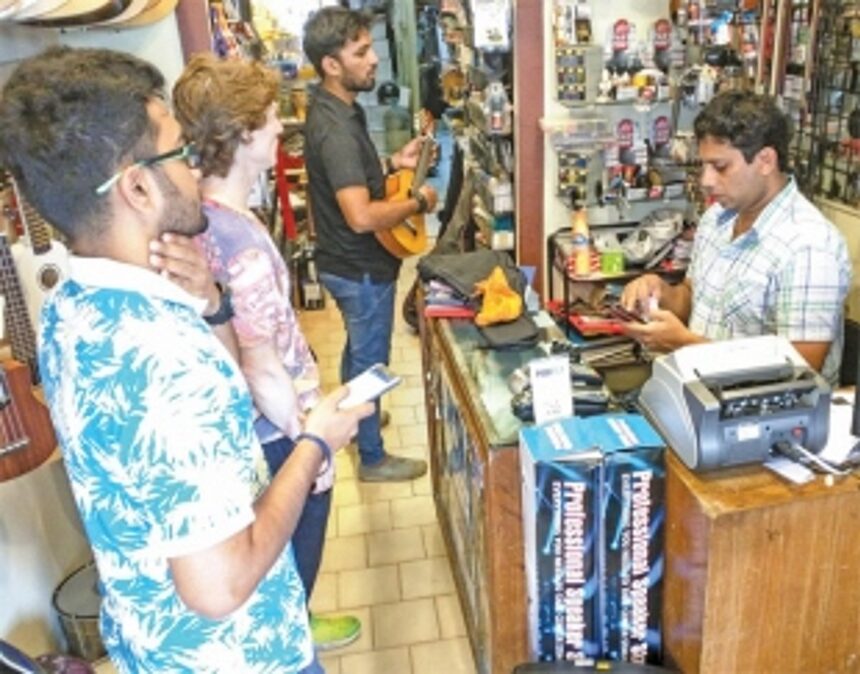
At a second music
store in the state, one potential customer pointed out, “I need to buy a better
guitar and amplifier to perform live. Though I wasn’t looking at buying one
right away, I’m simply rushing the sale, because if the price gets hiked beyond
what is already a stretch for me, I definitely won’t be able to afford it.”
The
full effects that GST has on the music trade will only be seen over time, but
one does hope that it does not, in any way, hinder the progress and prowess of
many of Goa’s musically-talented youth simply due to purely a price-point.