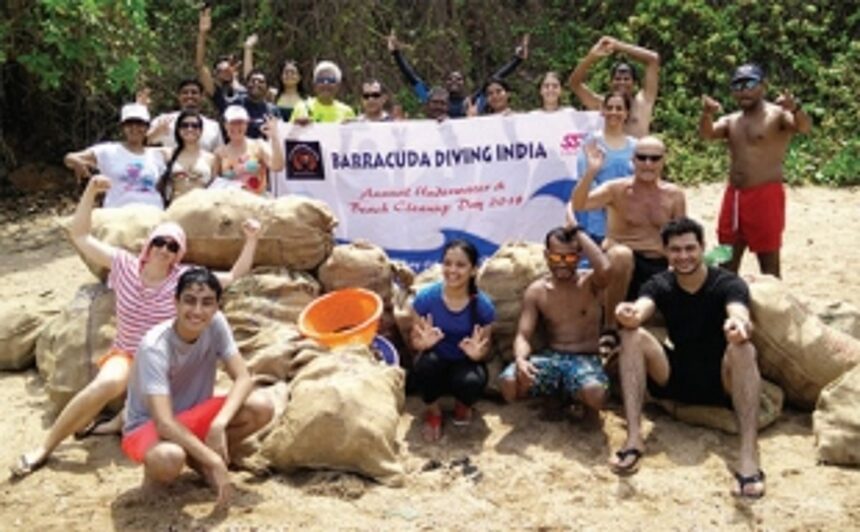
It was extremely hot and humid on Sunday, May 6, 2018, but that hardly deterred 25
determined, citizen volunteers from boarding a motor boat to St George’s island
to clean up its beach.
Part of local NGO Coastal Impact’s annual
St George’s island beach clean-up activity, the volunteers this year comprised
young marine biologists, the well-known author Sudeep Chakravarti, waste
management expert Clinton Vaz, his wife Emma, a few college students,
home-makers and members of the Barracuda Diving team.

As is the practice each year, one half of
the group cleaned the beach, while the other half dived underwater near the
beach to retrieve waste and junk that had reached the bottom of the sea.
The waste that the group encountered was
quite similar to last year. There were hundreds of beer and liquor bottles,
hundreds of plastic water bottles, paper plates, plastic cups, half-opened
masala packets, footwear, plastic bags, broken glass pieces and a whole lot of
assorted junk. However, the total waste that was segregated and sacked in gunny
bags was less than last year.
The total this year was 24 gunny bags, that comprised eight bags
of plastic bottles, seven bags of assorted waste, six bags of beer and liquor
bottles, two bags of metal tins and one bag of broken glass, all weighing a
total of 300 kgs. The waste was later sent to the state government’s Saligao
waste treatment plant.
Venkat Charloo, trustee, Coastal Impact, attributed the reason
for the drop in quantity of waste to fewer tourist boats coming to St George’s
Island in the last one year. He feared that there could be waste accumulation
elsewhere, like the Monkey beach near Vasco and Picano Island, which are being
frequented by tourist boats.
The enthusiasm of the volunteers had to be seen to be believed.
Even as the summer sun burnt their skin and parched their throats, they
continued with the back-breaking work with huge smiles.
Shruti Shah, a young marine biologist from the National
Institute of Oceanography (NIO), said, “This is my first beach clean-up. It is
a great experience. Doing something for the environment, which gives us
everything, from shelter to water to the food we eat, is very satisfying for
the soul.”
While her colleague, Larissa Menezes, a doctorate scientist at
the NIO, said, “The experience is as satisfying as it is saddening. Each time
we have gone out for a family picnic, we have made sure to carry garbage bags.
Enjoying nature should not be at the cost of her destruction by polluting and
choking her with anthropogenic wastes.”
Noted author Sudeep Chakravarti, a Coastal Impact member who
also volunteered in the clean-up activity, said, “I try and participate in
clean ups on most years, and this year the experience was similar: disgust and
anger at the pollution and waste, followed by a feeling of renewed hope and a
fuelling of fortitude.”
On the solutions front, Chakravarti was of the opinion that
tourism to these islands should be regulated. “There should be a no-garbage
policy for the islands and beaches of Goa. There should be high fines for those
who flout the rules,” Chakravarti said.
Charloo was keen to take up Goa Waste Management Corporation
(GWMC) chief, Sanjit Rodrigues’s suggestion to arrive at a solution by taking
into confidence the various stakeholders involved.
Rodrigues
had told Café (May 5 edition) that a permanent solution could be explored after
convening a meeting of the tourist boat operators, the department of tourism,
related NGOs and the GWMC. “A combined effort to understand, educate and
implement is required. We will be happy to give it a start,” Rodrigues had
said.