While most families in Goa start their day with the hustle and
bustle of getting ready for school, things are different in the
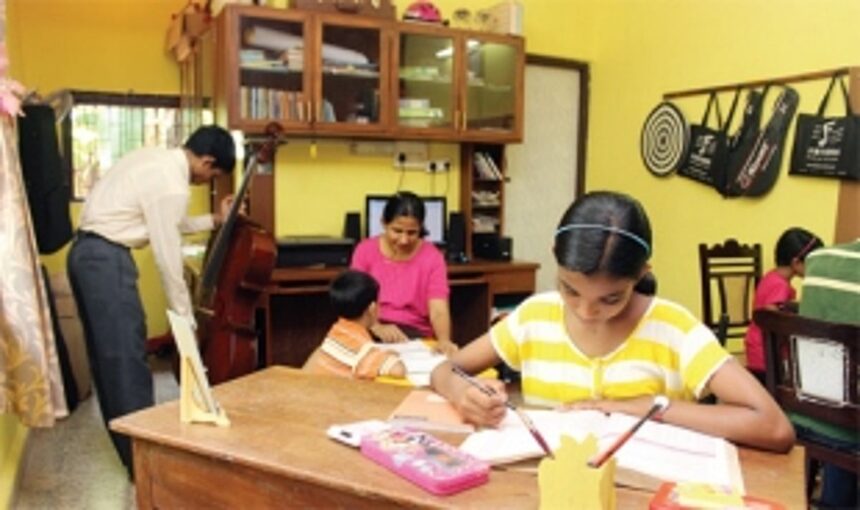
Vaz household. This family from Verna begins their day with Mass in the morning and once they are back home, they enjoy a hearty breakfast before the five children open their books
and start studying. At home. Under their
mother’s watchful eye. Avoiding the hassle of
pick ups and drops, tiffin boxes and heavy bags, this family has adopted the
homeschooling method of education for their children.
Mother to
Luke, Jerome, Maria, Clare and John Paul, Dr Zenita Sequeira Vaz gave up her
practice to dedicate more time to her children. She has structured the schedule
for her children and they are well disciplined to understand the importance of
their studies. She has been homeschooling her children for the last 11
years. She gets the syllabus from the NCERT/ ICSE/CBSE board and teaches the
children accordingly. Her elder son is studying the class XII syllabus, and her youngest, class I.

“We save a
lot of time and we have our own pace of studying the subjects. Each of the
children has their own individuality without being forced to study. Travelling with the children also becomes easier without the
restriction of attendance. It is not difficult to cope up with the syllabus. I
had a teacher coming home to teach maths and science when my elder son was in
class X and a Portuguese teacher for Jerome for three years,” says Dr Zenita,
wife of Lewis.
Besides
academics, the children also excel in music with Luke
learning the viola, Jerome, the piano, trumpet
and cello, and Maria playing the
violin. In the evenings, the children play badminton, football and cricket with
the children in the neighbourhood. “The children don’t participate in any
competitive sports but play to be physically fit and interact with children of
their own age,” she adds.
Buleta
Fernandes from Nachinola, Aldona is homeschooling her eight children, with the
eldest son now studying Class XII in the open school. Her aim was to keep the
children away from peer pressure. “I actually thought of pressure in the school
and how it could be avoided if they were studying at home. My elder son was
studying in a CBSE school till Class III but there was a lot of peer pressure
from the students. My eldest daughter and second son were also in the
same school, just a class apart, and I felt
it was difficult to cope up with their demands. They wanted money instead of
taking tiffin from home and there was peer pressure with regard to attire too as we prefer to dress modestly,” says Buleta, mother of four sons
and four daughters. Her youngest daughter is two years old. She was inspired to
adopt the homeschooling method when she
met missionaries from Finland.
Being a
member of a group of homeschooling parents, Buleta feels that more parents have started homeschooling and this year itself the meet will have more than 50
parents. “The advantage of homeschooling is that the children have a lot of
free time and can do other activities like cycling, gardening and also choose
what they want to study. I was at home with the children with no maid but we
had a teacher who would come home to teach the children, especially
for practicals. Regardless of which class they were studying in, all eight were
interested in learning the practicals. It is also important to evaluate the
children every year and I get test papers to evaluate them at home,” explains
Buleta.
Nadisha
Coelho James from Soccoro is one of the first homeschooled children in the state. She is now doing her PHd in Psychology.
Daughter of Anna and Valentine Coelho, Nadisha was also a lecturer after
completing her Masters in Psychology in Mumbai. “The advantage of studying at
home is that I have my own space and though I had the opportunity to study the
subjects I wanted, I chose the regular school subjects. When
students don’t understand the subject, they dislike it. When they study on their
own, their individual needs are met. I used to get question papers from my
friends to answer and get my mother to correct it, just to see where I stand,”
says Nadisha, a sister to four.
“In the morning, we would study for three hours
and that was enough to concentrate on the lessons and learn on our own. In the
evenings, we were free for music and I used to go for gymnastics, swimming
and even creative writing classes,” adds Nadisha.
A Catholic Homeschooling Seminar will be held on June 3, 2017 with a
panel discussion