Tender coconuts are undoubtedly one of the
best natural means of respite from this scorching
heat that has currently gripped the state of Goa.
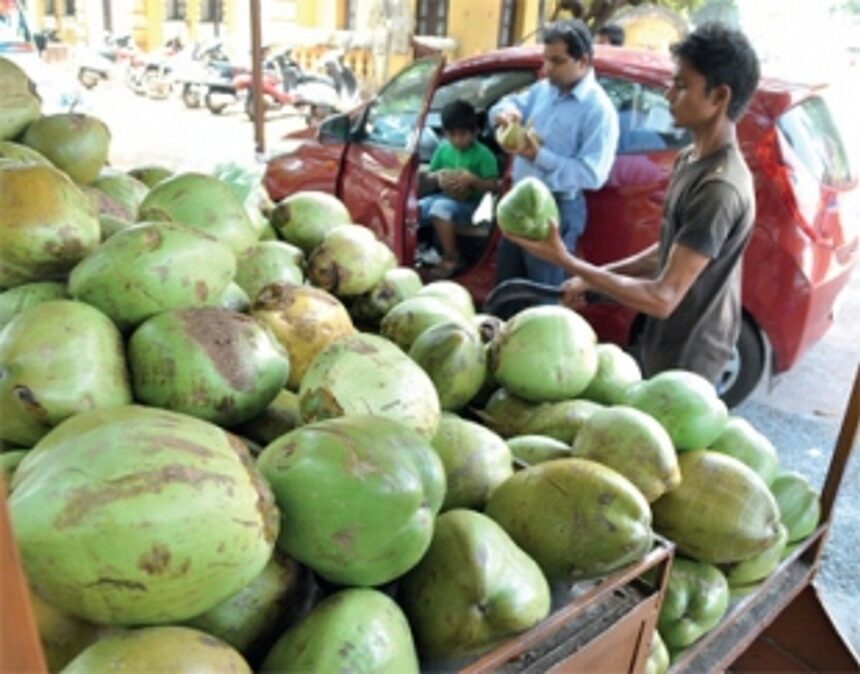
Along many routes in Goa, such as the Agassaim-
Goa Velha bypass road, it is difficult to miss the
tender coconut vendors sitting by the roadside
waiting for their customers who often pull over in
a bid to relish this local Goan produce, or so they
think. Although coconuts are widely produced
across the length and breadth of Goa and are
easily available for the various purposes that they
serve, the tender coconuts that are also widely
available, as weird as it may sound, are not locally
produced but come from Davangere in Karnataka.
Raghunath Joshi, Agriculture Officer,
Publication, Directorate of Agriculture, says,
“We are promoting dwarf variety plantations
such as Chowghat Green dwarf and the hybrid
varieties which yield more tender coconuts. The
government is trying to increase the subsidy from
the current Rs 20,000 per hectare on the hybrid
varieties because it is costly. D J Plantations
in Sanguem has developed hybrid varieties
which they are selling for Rs 300 per seedling.
The government of Goa is currently giving 50%
subsidy on the variety.” According to Joshi,
presently, the most commonly available Goan
coconut varieties – Calangute and Benaulim, are
both tall versions of coconut plantation. Getting
these varieties of tender coconuts is not cost
effective as one has to first get a plucker to climb
the tall trees. Pluckers are not easily available
as the younger generation is not keen on taking
it up as an occupation. Therefore, most Goans
choose to dry the coconuts and use them for
copra and extracting oil instead.
A tender coconut costs 35 rupees along the
coastal belt whereas in the cities, it costs 30
rupees. It is interesting to note that almost 95%
of the tender coconut vendors in Goa are non-
Goans. According to Joshi, “Young Goans, even if
unemployed, have been shying away from selling
tender coconuts to make a living.” While doing the
math, Joshi says, “There is a decent margin for
profit that one may consider making use of. One
patch of Green or Yellow dwarf variety of coconut
yields up to 30-35 coconuts. In a plot of 2000
square metres, one can plant almost 32-40 trees. In
a month, even if 20 trees are harvested and if you
choose to sell each coconut to the vendor for Rs 15,
one can easily make 10,500 rupees per month.”
After considering all the above points, it seems
that sampling a Goan tender coconut is no easy
task, even at the local vendor… but there is good
news. According to Joshi, a number of Goan
farmers are now venturing into dwarf variety
plantation in order to yield tender coconuts.
Varieties like Green, Orange and Yellow dwarf
and Gangabondam are being opted for and soon
we may be able to see more of locally produced
tender coconuts in the market.