Traditions of ancestors need to be maintained and preserved for posterity and not destroyed as per modern conveniences. Years back, the ‘zomnivhele fell’, as they were rightly termed, were introduced by our ancestors to the audience purely on any flat ground, where no curtains or panels prevailed and expenses for the shows were to the minimum.
It was a direct presentation of three, four folk plays in colourful costumes and several songs of 12 lines each interspersed in each play. The musical score would be provided by musicians playing only the blowing instruments and the drums.
But as years passed by, sea changes came about in the ‘zomnivhele fell’, thus destroying the essence and tradition of those folk plays. Its integrity got lost, leaving behind nothing worthwhile for the future generation to enjoy.
After formation of the Tiatr Academy of Goa (TAG) in 2009, under the leadership of Tomazinho Cardozo, many schemes came into existence regards art and culture of Goa. And one among them was the ‘zomnivhele khell’ competition which helped promote traditional folk plays.
During his tenure as the president of TAG, Cardozo insisted that the ‘zomnivhele fell’ competition should strictly be presented on the ground instead of the tiatr stage. He also stressed upon the blowing instruments as part of the folk plays, rather than the introduction of electronic gadgets, despite the insistence of some ‘fell’ directors to bring in electronic instruments.
Cardozo further stated, “in the 50s when Antonio Moraes took ‘fell’ on the stage for the first time, it was termed as ‘khell tiatr’ and it no longer existed as ‘zomnivhele fell’. “If we are trying to preserve the culture of Goa,” he said, “and especially the traditional folk plays, then ‘zomnivhele fell’ have to be present strictly on the ground.”
For 10 years the said competition was presented by TAG at Kala Academy’s amphitheater and the natural ambience was apt for presentation and viewing of those selected folk plays. But with the blowing instruments, electronic equipment also found a prominent place there, thus destroying the traditional setup of the folk plays.
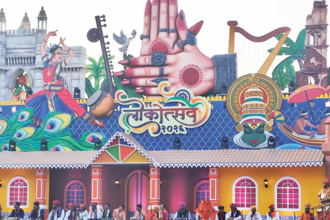
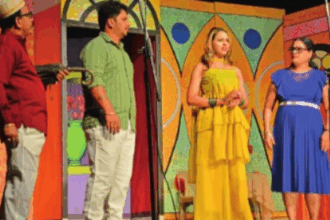
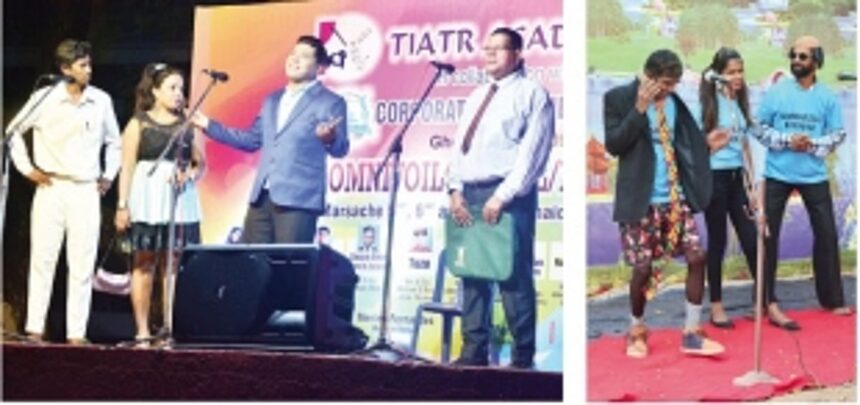
This year the folk plays staged for three consecutive days witnessed a sea change, moving from the plain ground to the tiatr stage when they were presented at Azad Maidan, Panjim, due to renovation work being carried out at Kala Academy. The green lawns around the place sufficed to do justice for its presentation, but it was ignored.
When asked about the change of guard, the president of TAG, Menino de Bandar said that looking at the convenience of the audience the decision was taken. “Merely taking the folk plays from the ground to the stage will not change the essence of tradition and the format of the plays,” he stated.
Noted tiatr artiste, Bonny Pereira, who has been participating in folk plays presented by his brother, Vitorino Pereira, since childhood, recalls that ‘zomnivhele fell’ never found a place on the tiatr stage. “They were always staged on the ground and people would gather around to witness them at every nook and corner of the village. Ground presentation was convenient for the troupes as they could move faster from one place to another with the shows,” he mentioned nostalgically.
“Among the musical instruments it was a trumpet, saxophone, clarinet, drums and a box guitar,” Pereira recalled. “There would be no script,” he said, “but after brief dialogues, more focus would be laid on 12-14 songs rendered in voices.”
“The presentation of four different folk plays by each director included decent, comedy, evil one (devcharachi) and one based on the Hindus,” Pereira disclosed. “Regards the costumes,” he revealed, “there would be one colourful uniform by all artistes for all the plays, except for some unique characters like the landlord, policeman or a priest.”
The criteria to select folk plays for the competition also appears to be faulty as good plays could go rejected, thus depriving the audience to enjoy good entertainment. “The directors winning first three prizes could be given direct entry for the following year,” stated Rafael Pereira from Fontainhas, Panjim, “while the remaining entries could be selected based on the popularity of the folk plays during the Carnival festival.”
“Compared to previous years,” Pereira said, “this year there were staging of four folk plays each day. And by the time the fourth folk play would be presented on stage, the audience would disperse from the venue, thus leaving the artistes on stage disheartened.” “So instead of staging four folk plays each day,” he suggested, “instead of three days, four days of presentation could be introduced, but restrict only three folk plays per day.”
“If blowing instruments were strictly followed in the folk plays during yester years, then it has to be maintained and preserved for posterity,” said Anthony de Velim, a trumpeter, who was part of the ‘zomnivhele fell’ in the Salcete taluka. “Many ‘fell’ directors find it economical and much cheaper when they rope in solely the keyboardist and the drummer in their troupes,” he added.