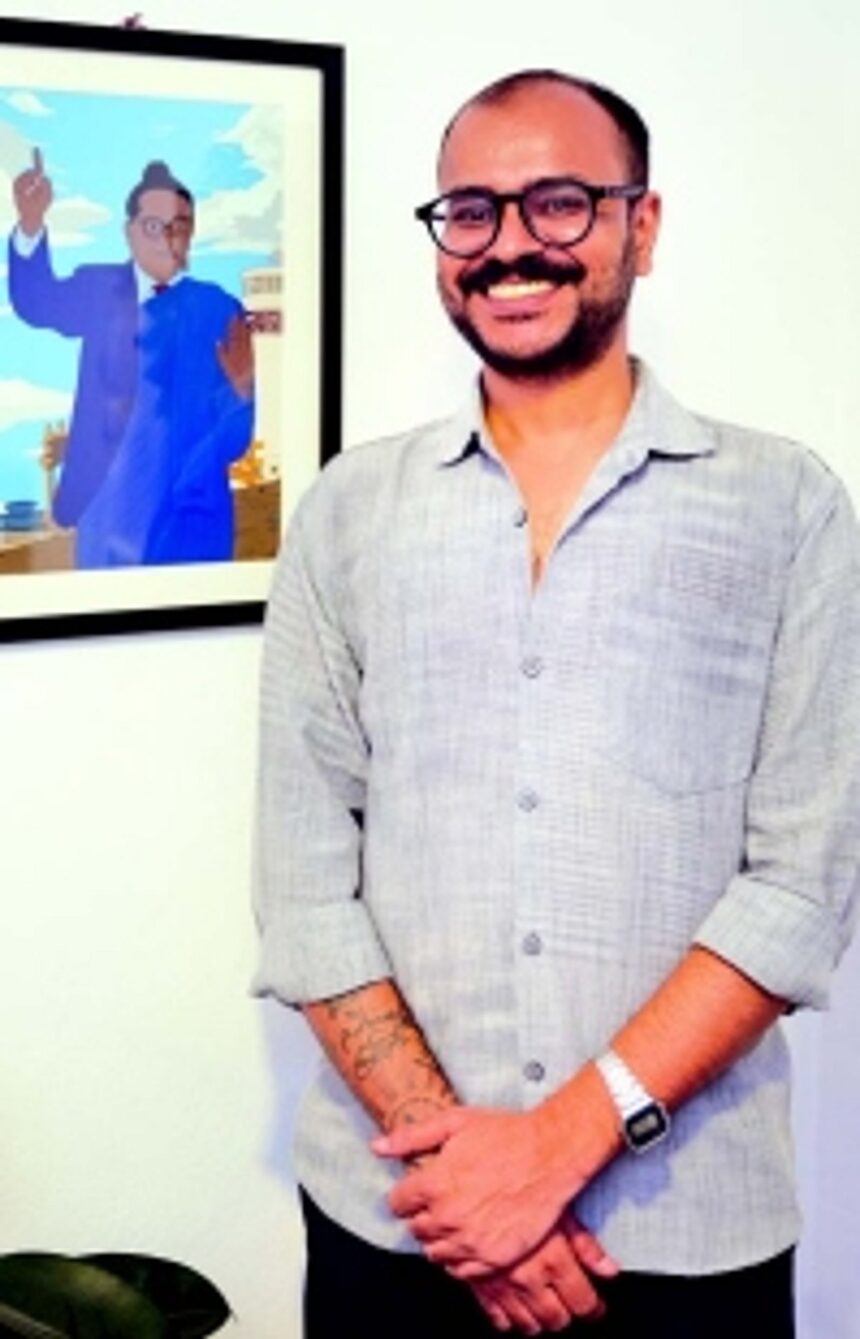
Siddhesh Gautam is a progressive thinker artist who advocates for inclusive progress. With his sharp wit, he humorously reflects on how societal shifts can challenge hierarchies. He recounts how, in his village, Dalits once lived in the outskirts while upper castes occupied the entrance. However, when a new highway was constructed, it ran through the Dalit side, symbolically placing them at the forefront of the village. This change, he notes with pride, shows how progress can unexpectedly empower marginalised communities.
He has always had a deep connection with Goa, his relationship with this coastal paradise is full of personal history and artistic inspiration. Raised in Uttarakhand, Gautam’s formative experiences in Goa left a lasting impression on his creative mind. His father’s work in Goa during his childhood facilitated this connection, with early morning walks along the Mandovi River gave him a sense of the state’s unique flora and fauna in his memory. Gautam reminisces about collecting rocks and observing the distinct trees that were so different from those in Uttarakhand. This early engagement with Goa’s natural environment fuelled his lifelong practice of journaling and collecting, a habit that he believes carried the essence of Goa.
“Goa is one place which has kept its beauty intact,” Gautam reflects, “So I think in that way, Goa has served its purpose for me as a place where I find serenity, where I find peace of mind and verify new ideas.” His visits to Goa have always been a source of inspiration. He recalls attending a concert where a performance by the Noorani Sisters impacted him during a time of nationwide protests against the Citizenship Amendment Act (CAA). The song ‘Allah Hu,’ performed during the concert, evoked a deep sense of freedom in Gautam. It was in the middle of this concert that he decided to change his social media profile name to ‘Bakery Prasad Azad,’ a symbolic act of resistance and self-expression. This moment marked a significant point in his artistic journey, one that further solidified his connection with Goa.
Gautam’s relationship with Goa is personal and embedded in his art. He observes that the colours of Goa—its yellows and blues—have subconsciously influenced his work. “There is a bit of a hint of the yellow and the blue that you see in Goan houses in my work,” he notes. This realisation comes to him as a revelation, as he reflects on how his exposure to the vibrant hues of Goa during his childhood has permeated his creative palette. His approach to art was not shaped by formal education or exposure to the works of masters but by his observations of the world around him, particularly the city of Panjim, which remains one of his favourite places.
Panjim, with its colourful streets and rich cultural history, has been a recurring source of inspiration for Gautam. Having his first solo exhibition in India in a gallery set up, at the Museum Of Goa, Gautam believes “is essential for an artist, the Museum allow for genuine interactions with the audience, unfiltered by the formalities of a regular gallery setting. It is a place where I think they also think of having a reason behind creating something,” he says, “and I resonate with this thought—there should be a reason behind every creation.”
For Gautam, art and activism are two sides of the same coin, running parallel through history. He traces the roots of art back to the cave paintings, which served not as gallery pieces but as knowledge-enhancement tools, helping early humans understand their environment. Gautam believes that art has always been used as a form of resistance, a counter-narrative to the dominant powers of the time. “Art cannot be away from political ideology,” he asserts. “Even if you make a flower or a butterfly, you made it because of a political ideology that you follow.”
Gautam’s belief in the power of art as a form of dissent is rooted in his understanding of history. He cites examples like Picasso’s Guernica, which, despite the artist’s extensive body of work, is remembered for its powerful anti-war message. “Doing art is not a unique thing, but doing it for a purpose makes it unique,” he explains. He believes that everyone has the potential to be an artist, but what distinguishes an artist as a professional is their ability to communicate the thoughts and ideas that lie within their mind. This communication, according to Gautam, is inherently political, as it stems from the artist’s worldview and ideological stance.
Gautam’s own journey as an artist has been deeply influenced by technology. He recalls the early days of his career when he struggled to gain recognition from traditional galleries. It was only when he began sharing his work online that he found an audience that resonated with his creations. Digital art, for Gautam, has been a game-changer, allowing him to create and share his work without the financial and logistical constraints of traditional mediums. “I have made more than 1500 artworks,” he says, “had I been doing it on a canvas with paint, I might not even be able to afford it.” His embrace of digital mediums is practical and philosophical. Gautam sees the silicon in his digital tools as an extension of the earth, just like the materials used in traditional art forms. He believes that each technological advancement offers new opportunities for expression, especially for those who have been historically marginalised. “Whenever technology comes, it is the oppressed people who can use it best,” he observes, drawing parallels between the advent of cheaper printing presses, which empowered Ambedkar, and the accessibility of digital art tools today.
Gautam is particularly excited about the potential of digital art to reach a global audience. He believes that the internet has opened up new possibilities for artists to showcase their work and connect with others, regardless of geographical boundaries. This global connectivity, he argues, is leading to a cultural revolution, where diverse voices are being heard and new artistic movements are emerging. He cites the example of artists in Gaza, who, despite the ongoing conflict, are using digital platforms to create and share their work with the world.
Despite the challenges and uncertainties of the present, Gautam remains optimistic about the future of art and humanity. He believes that the accessibility of knowledge and creative tools will continue to empower individuals and communities, leading to a more equitable and just world. “We are in a very interesting time where accessibility to knowledge is more,” he reflects. “This is the time when maximum people have literacy, they have access to libraries and other things.” His exhibition is aptly named –‘We The People (Too)’ which will be on display from August 25 to September 8 at the Museum of Goa, Pilerne. Through his work, he challenges the status quo, and in doing so, he reaffirms the idea that art, in its truest form, is a reflection of society and a catalyst for its transformation.
For Siddhesh Gautam AKA Bakery Prasad, the journey of an artist is one of constant learning, exploration, and resistance. His connection with Goa, his embrace of digital art, and his commitment to using his work as a form of activism all reflect his belief in the transformative power of art. As he looks to the future, Gautam is eager to see how technology will continue to shape the world and the role that artists will play in this evolving landscape. “I am very excited to see how the world goes,” he concludes, “and I think we are moving towards making this violence a little less and discovering the meaning of civility, of being civilised.
Siddhesh Gautam’s relationship with Goa is personal. He observes that Goa’s yellows and blues have influenced his work. “There is a bit of a hint of the yellow and the blue that you see in Goan houses in my work,” he notes. This realisation comes to him as a revelation, as he reflects on how his exposure to the hues of Goa during his childhood has permeated his palette. His approach to art was neither shaped by formal education nor exposure to the works of masters but by his observations of the world around him, particularly the city of Panjim, which remains one of his favourite places in the world. “Goa is one place which has kept its beauty intact,” Gautam reflects