The here and now of any culture and civilisation
lies in the revisiting of its past. In one given case, the
past weaves itself into a time warp and makes its way into the present. Set
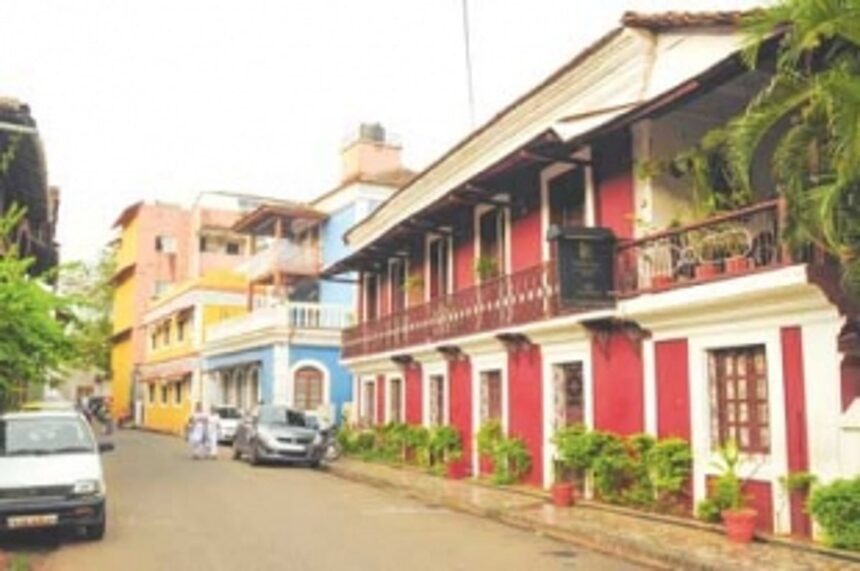
apart by its vibrancy in terms of colour, architecture and the fact that it is
one of the few hamlets of its kind in the country, Fontainhas has all the
elements required to make the everyday man fall in love with and quite
literally take a stroll down memory lane. Here, one is not encountered by
decrepit structures falling into a state of disrepair, but rather, closely set
multi-coloured structures, each of which encompasses an air of romance and
historical significance.
One of its many famed landmarks is Panjim
Inn which is in the safe hands of current custodian and incumbent Jack Sukhija.
He shares the family’s tale that made this place what it is. “Panjim Inn is our
family home built by my paternal ancestor Francis Assisd’Silveira. It was
renovated and converted by my father Ajit Sukhija into a heritage hotel
starting in the mid 1980s. Our family was full of doctors and as such, my father’s
first intention was to convert it into a hospital. But as other family members
were not keen on it, he looked at other alternatives. Having just returned from
a six-month sabbatical in Italy, he was highly influenced by how they had made
heritage buildings economically sustainable via tourism. From there he slowly
started converting it into a quaint hostelry and found that he enjoyed
restoration. In the mid 90s we were classified as Goa’s first heritage hotel,”
he says.
Ajit’s tryst with Fontainhas didn’t end
there either. He went on to buy and restore two other buildings in the
locality; The Panjim Pousada, a traditional Hindu home belonging to the Ghanekar
family in 1997 and the Panjim Peoples, Goa’s first English medium school.
Home to the likes of Percival Noronha, a
man who has been immortalised in Goan history, Fontainhas has many little
facets that make it immensely charming. The area is home to Viva Panjim, an
authentically local restaurant operated by the ever effervescent lady of the
premises, Linda. Right next door, separated by merely an alleyway, is the
Afonso Guest House, which online travel portals (through their own manner of
rating) believe should be rated higher than some of the starred resorts in Goa.
In more recent times, the additions of Luis Filipe Menezes’ quaint heritage
hotel La Maison and O Fogo, the restaurant within its premises, have made their
very welcome presence felt.
Journalist, translator and lifetime
resident of the area, Jovito Lopes, shares his views on the trials and
tribulations of residents. “I think that the government’s role should have had
some effect by now. For instance, as families grow, they are torn apart, as
houses in Fontainhas aren’t large and people need to relocate, not out of choice,
but because of a dearth of space. We are not allowed to reconstruct and expand,
but we aren’t given provisions to make other arrangements either.”
Zito de Gouveia Pinto is the occupant of
the house that served as Goa’s first ever museum, an initiative of his
ancestor, Miguel Vicente de Abreu. “In recent times, there have been
initiatives that have been undertaken by certain individuals. These include the
likes of the heritage walks undertaken by Jack Sukhija and Dr Luis Dias.
Similarly, certain ventures such as Luis Filipe Menezes’ new undertaking show
that as long as there is an injection of financial stability, there is hope at
sustaining any such revival attempts.”
As long as there are the everyday heroes
that look to keep a little bit of the past, the tale of Fontainhas, and with it
the tale of Goa, will endure.