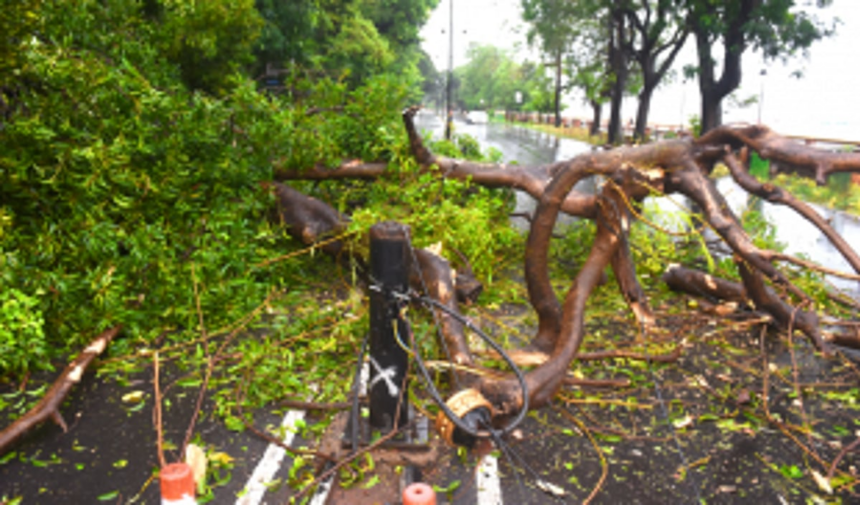
Wherever in Goa you live, you only have to step out of the house to get an idea of the amount of damage that has been caused by Cyclone Tauktae that came closest to Goa on Sunday, before proceeding further North. Imagine what you see in your neighbourhood as the scene across Goa and then you can appreciate the damage that has been caused. It was a severe cyclone that left behind a trail of destruction. A full day after the cyclone moved away from Goa, the signs of the devastation it caused are still visible. The forecast of rain still exists, so Goa has to still be on the alert, while large parts of the State are still in darkness.
As per the government, the damage wrought about by Cyclone Tauktae will take a few more days to be fully assessed. This will happen, while relief work is already on, prioritizing power supply to hospitals and pharmaceutical companies due to the pandemic. The roads that have been blocked, the trees that have been uprooted and the power that has been cut off are being restored on a war-footing by the authorities. Chief Minister Dr Pramod Sawant has asked people to have patience as it will take two days to return to normalcy. Though there are complaints, especially on social media, that the pace of work to clear the damage brought about by the cyclone passing over the Arabian Sea is slow, the fact is that this was Goa’s worst experience with a cyclone and the return to normalcy will take time.

Towns and villages are without power and water supply. But if people venture out of their neighbourhoods, there is evidence that the Fire and Emergency Services, the Power Department and the Public Works Department are out there doing their best to restore the disrupted facilities. Even while it was still pouring and there were gusty winds blowing, the department staff was on the streets doing the best they could. Of course, a number of streets and roads still have trees fallen over them, but when hundreds of trees have been uprooted clearing them will take time. Where the Electricity Department is concerned, the estimate is that 700 poles and 200 transformers have been damaged.
Against this background, Goa needs to seriously consider underground cabling for its power supply system across the State. Today, all tasks are powered by electricity so if power cannot be restored immediately it is not just the people in their home who are suffering but industry too gets hit with losses piling up. Panjim, that has underground cabling, did not experience the power supply disruption, while its neighbouring villages which are still supplied power with overhead cables did remain in the dark for hours. The cost of taking the supply system underground may be enormous, but if it offsets the problems caused of disruption of supply due to natural calamities, then why shouldn’t it be considered?
Yet, one passing cyclone has effectively paused life in Goa. What does this say about the disaster management in the State? Shouldn’t the aim be to do better? Cyclone Tauktae was forecast days in advance and even upgraded to a very severe storm. There is no conceivable reason why Goa was not better prepared to meet it. The storm didn’t come unannounced; a team of the National Disaster Response Force arrived in Goa ahead of the cyclone. There were marathon meetings held by the district disaster management teams prior to the cyclone, so the response was expected to be better. Cyclone Tauktae has been a revelation of just how unprepared Goa is to meet any disaster.