Infrastructure development has been one of the high points and flagship programmes of the present government and therefore there has been a great emphasis on the ‘double-engine sarkar’-led development in Goa. While there is no doubt that road infrastructure received an added impetus during the last decade, there is a growing concern about the rising number of fatalities on roads in the State. There has not been a single week in the calendar in 2023 when Goa did not witness a fatality on the road.
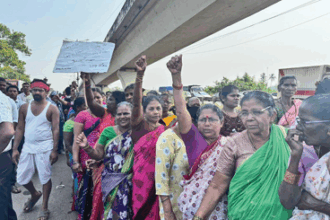
In the wake of the recent fatal accidents at Naibag junction, Poroscodem, locals have demanded that the authorities immediately construct a flyover at the accident-prone junction. The Naibag junction, which has turned into an accident-prone area along National Highway 66 (old NH 17), has witnessed numerous fatal accidents due to improper road alignment and lack of a flyover. The frustrated locals questioned the government for not fixing responsibility and demanded that a flyover be constructed immediately.
On the eastern side of the State, in response to a series of accidents along the Bethora-Borim bypass, locals have highlighted the absence of adequate lighting and signage as key factors contributing to the accidents. The ongoing widening of the four-lane Bethora-Borim bypass, covering approximately six kilometres along the Belagavi-Panjim National Highway 748 (old NH 4A), has exacerbated concerns, with vehicles now traversing certain sections at higher speeds, causing apprehension among residents. Requests for the installation of proper street lighting have intensified, as navigating the unlit stretches of road poses significant risks for pedestrians and motorists alike.
The government likes to indulge in misplaced priorities. While the people from the Cansaulim-Arossim-Cuelim and Velsao-Pale-Issorcim panchayats have been opposing the expansion of the railway tracks and the underpasses and the rail over bridges, the government is hell-bent on constructing them. On the other hand, villagers along the national highway expansion routes are demanding proper service roads, underpasses, illumination along the highways and flyovers at crucial junctions which have now turned into fatal accident-prone zones, however, the government is turning a deaf ear to these demands. The government’s attitude of not paying heed to the people’s demands is akin to Nero playing the fiddle while Rome burnt.
The National Highways Authority of India (NHAI) has seemingly granted blanket permissions to pathetically planned highways that are snuffing out the lives of innocent road users. The institution is perhaps functioning without any foresight of population expansion and the transition of rural villages into urban spaces. Or the officials haven’t taken into consideration that, unlike other large States where one will not come across human settlements for several kilometres of road stretch, it is just not the case in Goa. How the Ministry of Road Transport and Highways (MoRTH) even grant permission for these expansion plans remains a big question. In addition, while drawing up the plans, what role did the officials and engineers of Goa’s Public Works Department (PWD) play? Did they just watch while a disaster was being unleashed upon Goans or are they the masters of such a disastrous expansion plan? Didn’t they receive training in road engineering before the crucial master planning process?
Quality of work being carried out from Patradevi to Polem and Molem to Panjim leaves one stunned to think about the alleged voluminous corruption-smeared execution as concrete roads in other parts of the country provide a far smoother ride and drive. The number of cracks and potholes that these concrete roads have already developed leaves one to wonder about the life span of these roads. Goa’s legislators and city fathers are among those who take foreign trips, so it is expected they have also visited Indian cities where concrete roads have become a norm in road construction, and therefore they have experienced what is being pointed out. Then why is there so much silence from the public representatives over the poor quality of work? Or is it simply a case of ‘You scratch my back and I’ll scratch yours?’
Earlier this month, after the State Road Safety Council meeting, chairman and Transport Minister Mauvin Godinho criticised the absence of the government officials at the meeting and stated that their negligence compromises road safety. When the seniormost cabinet minister in the State points at officials, why is the government shying away from fixing responsibility and setting accountability for the bloodbath on Goan roads week after week, month after month and year after year? While there is an urgent need to fix responsibility, the government needs to redesign the plans and course-correct the fatal accident-prone zones to save the lives of Goans and tourists visiting the State.