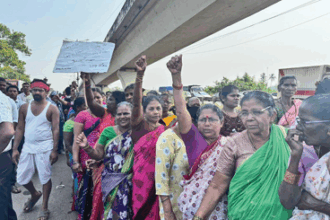
The Government Primary School in Dhavshirem, Ponda has 83 students and a sanctioned strength of five teachers. Since last week the students have been boycotting classes protesting the absence of teachers, as one has been transferred and the other has been sent for training. This is not the first time students of this school, led by their parents have boycotted classes. They had done so in July this year, and the reason for the protest was the same – lack of teachers. On Tuesday, the parents gheraoed the office of the Assistant District Educational Inspector (ADEI) at Ponda demanding that more teachers be appointed in the school. The boycott was called off after the department assured in writing that two permanent teachers would be appointed.
The main issue with lack of teachers at this school is that the classes are held during the second half of the day and lady teachers are not willing to be posted at this school as it delays their getting back home. Parents are also demanding that the classes be held in the morning period, so as to get around this problem. Parents have also complained that the school faces a shortage of teachers every couple of months as the teachers who are transferred to the schools get fresh transfer orders using political influence and the students are left without a teacher.
While the lack of students is a malaise across government schools in the State, this one school has a different sort of problem. Here is one school run by the government that has students, who are willing to study but it is the scarcity of teachers that is holding them back. And the reason for the scarcity of teachers appears to be transfers using political influence. Just how ironic is that? The future of 87 young children is being played around with, as politicians use their influence to get their constituents transferred from the school Do they not for even a single moment think of the children in the school, but only look at that extra vote that the favour of a transfer will bring them?
It is this kind of myopic vision of the political class that doles out favours for votes that ails governance in the State. The Dhavshirem school is but an example – a prime example – of how such a system affects the entire administration. It is not just in education that it happens, but in almost every department, where favourites of the political class are brought into positions of prominence, and on retirement given extensions in service so that they continue to serve their political masters. This can’t be allowed to happen, but with a society that has grown immune to this system, such instances are glossed over and the political class is allowed to have their way, almost always.
Worse, as seen in this protest, the trust factor in this administration is sorely missing. The boycott of classes was called off only after the department officials gave the parents a written assurance that teachers would be appointed and would not be transferred elsewhere. We have reached a stage when a government officer’s word is no longer trusted and only written assurances are acceptable. Responsible for this mistrust is the administration which in the past has not kept its assurances. Earlier this year the taxi operators withdrew their protest after a written assurance from the government on meeting their demands. Even earlier, workers recruited under the Goa Employment and Recruitment Society had also demanded a written assurance that their demands would be met.
Today it was the school at Dhavshirem, tomorrow it will be something else. In the eyes of the people, government credibility has been severely eroded. It will require a major gesture from the dispensation for the people to believe in the government again.