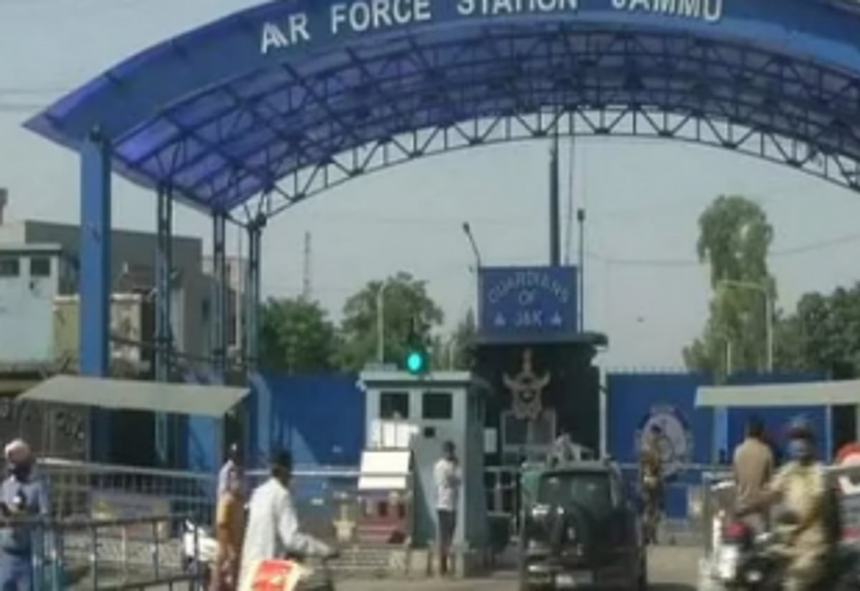
The progress is being built to ‘resume’ political activity in the region but at the same time efforts are also on by the anti-nationals to disturb any move by the Union government to restore full normalcy. Two explosives-laden drones crashed into the high-security Indian Air Force station (IAF) at Jammu airport in the early hours of Sunday. Two IAF personnel were injured in the explosions that took place around 1.40 am within six minutes of each other. The first blast ripped off the roof of a single-storey building at the technical area of the airport manned by the IAF in Satwari area of the city. The second one was on the ground, an official told media.
Union Defence Minister Rajnath Singh, who began his three-day visit to the Union Territory of Ladakh on Sunday, spoke to Air Chief Marshal HS Arora, Vice-Chief of the Air Staff of the IAF, regarding the incident. Western Air Commander Air Marshal VR Chaudhari is scheduled to visit the base to assess the situation. IAF Chief, Air Chief Marshal RKS Bhadauria who is on an official trip to Bangladesh, is monitoring the situation from there. It is a serious issue as how did a drone manage to enter a high security area is a question which is being raised in the review meetings. Rajnath Singh’s visit to Ladakh is aimed at taking stock of India’s military preparedness in the region in the face of a prolonged border row with China.
“Although the local police suspect that the drones were flown from across the border, it is yet to be established beyond doubt,” an official told a leading newspaper. Drones fly low and therefore cannot be detected by any radar system. Preliminary findings suggest that the target was to damage a helipad inside the station.
Speaking to reporters, Director General of Police of Jammu and Kashmir Dilbagh Singh said that another improvised explosive device, or IED, weighing five to six kilogrammes has also been recovered by the police. This IED was received by a terror group Lashkar-e-Taiba operative and was to be planted at some crowded place. “A major terror attack has been averted with this recovery,” said Dilbagh Singh. It is a clear indication that hostile neighbour in the north western borders will not allow normalcy to return in the Valley but due to high alertness of the Indian Armed Forces, such planned incidents are being scuttled.
With the abrogation of Article 370 and 35A, peace and normalcy in comparison to the time before the abrogation has returned. However, it is not complete. The unscrupulous and disturbing elements still manage to derail the peace by sporadic violence by means of bomb blasts etc, keeping the armed forces alert all the time. For the armed forces the situation remains the same but surely the number of incidents have dropped down.
In March this year, Union Minister of State for Home G Kishan Reddy said in the Lok Sabha that 244 terror incidents were reported in Jammu and Kashmir in 2020 in comparison to 594 in 2019, while 221 terrorists were killed in 2020 in comparison to 157 in 2019.
There have been intelligence inputs that Pakistan-based terrorist groups could attempt to target military bases with drones. After the drone attack on Saudi Aramco oil facilities in Eastern Saudi Arabia in September 2019, the armed forces held several meetings on this issue and put in place plans to procure counter-drone capabilities. Meanwhile, the Defence Research and Development Organisation (DRDO) has developed an anti-drone technology for short ranges which was deployed for the Prime Minister’s security during the Independence Day address in August 2020. In December last year, Navy Chief Admiral Karambir Singh had announced that the Navy was procuring Smash-2000 rifles to counter drones, among other measures.
The question now arises that all things are in place. The information and intelligence inputs are in order, the equipments to deal with drone attack is also in place, the intention to procure is also there but then why does the government take so long to procure such equipments? It is a matter of national security and actions should be taken in highest priority. The aerial distance between Jammu airport and the international border is barely 14 kilometres and it is understood fairly well that the terrorists chose their time, venue and mode of attack and very rarely the armed forces intercept them before the planned incident.