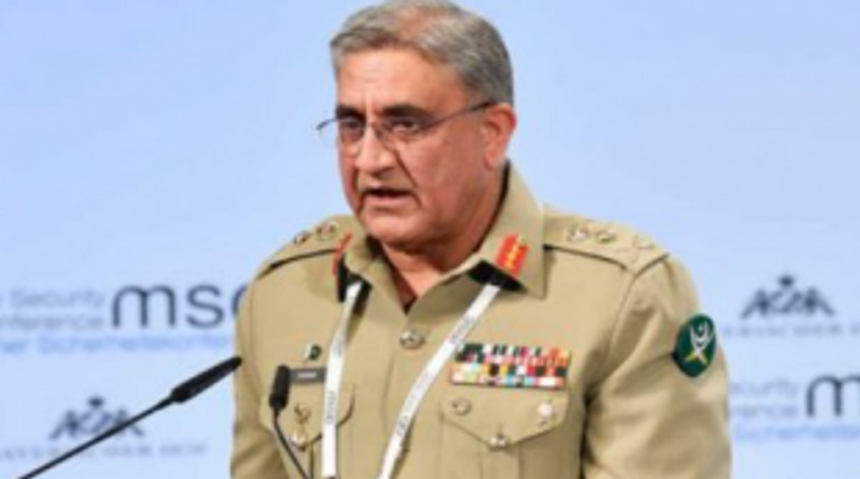
Outgoing Pakistan Chief of Army Staff (CoAS) General Qamar Javed Bajwa created controversy, saying only 34,000 Pak soldiers surrendered to India in 1971 war and not 92,000 as reported widely till date.
He also said that the country’s surrender during the 1971 war with India was not a military but a political failure.
General Bajwa further lashed out at the “anti-military narrative” of a section of the people and political establishment, wondering aloud why neighbour India’s military is “seldom the target” of similar criticism within the country despite its record of “human rights violations”.
General Bajwa is certainly suffering from delusions. Be it 1965, 1971 or in 1999, all these three wars with Pakistan happened with the active participation of Pakistani generals. In 1965 and 1971, the country was under Army rule. So, calling the 1971 defeat as political is a blatant denial of facts.
Though Pakistan is constitutionally a democratic parliamentary republic, the military has been in charge for half of its 75-year-long history. Since 1947, Pakistan has been ruled by four different military rulers under three different military coups (1958-71, 1977-88 and 1999-2008).
In an attempt to stop the cycle of long military rule followed by a brief stint of an elected government, the National Assembly in 2010 passed the 18th Constitutional Amendment. This amendment removed the power of the President to dissolve the parliament unilaterally.
Recent developments in Pakistan and the no-trust vote against Prime Minister Imran Khan suggests that the influence of Army has increased.
Coming specifically to 1971, General Bajwa would do himself a great favour by reminiscing his country’s history.
The Pakistan COAS said that 1971 debacle was political and not military.
After independence, two nations were created, India and Pakistan. The Punjabi and Urdu speaking Muslims lived in West Pakistan while Bengali speaking Muslims lived in East Pakistan.
But East and West Pakistan never got along.
The first bone of contention was national language issue. It was controversial, as Bengalis pressed for recognition of their lingua franca, while in the West, Urdu speakers, including Urdu-speaking elites from what became East Pakistan, opted for Urdu.
West Pakistani elites feared the majority of East Pakistan within the union. They came up with the formula of One Unit for West Pakistan in 1955 that would place it at parity with the East. This was a signal to the Bengalis of the mistrust of their brethren in the West Wing.
Under the rule of dictator General Ayub Khan, there were multiple occasions when the rights of East Pakistan people were suppressed.
Army Chief Gen Yahya Khan, who took over from Ayub Khan, promised free and fair elections in 1970.
The Awami League led by Sheikh Mujibur Rahman swept the polls in the East. Zulfikar Ali Bhutto’s Pakistan People’s Party got 81 out of the 132 seats in the West, primarily in Sindh and Punjab.
But Awami League was denied power. The protests started. A brutal crackdown on protesters by the Pakistani army started on March 26, 1971, named Operation Searchlight. At least three lakh East Pakistanis people were killed, women raped. Around 10 million refugees entered into India.
On December 3, 1971, Pakistan declared war on India and after 14 days, 90,000 Pakistani soldiers on the Eastern front surrendered before Indian Army.
Now, this entire history debunks all the narratives of General Bajwa. First and foremost, it is well recorded fact that 92,000 soldiers of East Pakistani military surrendered.
Even if you exclude Air Force, Navy and Police amongst those surrendered Army alone wouldn’t be less than 50,000. Also calling the 1971 war debacle as political is an attempt to absolve the Pakistani Army of all the wrongdoings because it was a Martial Law administrator in General Yahya Khan who was the President of Pakistan.
In Pakistan, not even a twig doesn’t move without its permission. It was Pakistani Army which orchestrated the brutalities against their own brethren in East Pakistan, that sowed the seeds of Bangladesh formation.
In fact, General Bajwa was self-contradictory when he said that people of Pakistan dislike its Army because of its involvement in politics.
Also, before accusing Indian Army of human rights violation in Kashmir, General Bajwa should remember that the Pakistan Army unleashed one of the worst ever genocides in East Pakistan and continues to quell the Balochi people mercilessly. The Frontier Corps, Inter-Services Intelligence (ISI) agency and other groups have been accused of a decade-long campaign in which Baloch nationalists are picked up, tortured and then killed. Pakistani Army General, however, may like people to believe him, he can’t undo the dark history of the country, written by his predecessors.
In the information era, people are no longer naïve. At the click of a button, entire past and present excesses done the Pakistani Army are available on the screen.
If Pakistan remains in a state of denial and looks for scapegoats for sharing the burden of Army’s tyranny, then it can be rest assured of further disintegration. Baloch rebels are making life difficult for Pakistani establishment, while Tehrik-e-Taliban Pakistan, an offshoot of Afghan Taliban in Pakistan has mounted heavy casualties on Pakistan army.
Wake up Pakistan, before everything is lost.