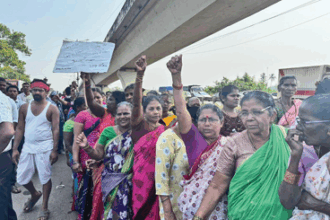
On Wednesday four villagers were detained and verbally abused by Police Inspector Sagar Ekoskar and his Valpoi police team for attempting to address a press conference without seeking written permission from authorities as Section 144 of the CrPC is in force in the wake of the COVID-19 pandemic.
However, the manner in which the police, especially PI Ekoskar acted, which is most certainly as per the diktats of the political bosses, is highly condemnable and there needs to an inquiry initiated into the episode to determine on whose instructions the cops acted. Yes, the IIT is a great project for Goa and will immensely help Goan youth, who were otherwise seeking admissions hundreds of kilometres away. But the police action indicates that the government is using police force to suppress voices of dissent and show utter disregard to people’s issues and demands.
It is time to remind the government and the Goa Police that in a democracy, people have the right to raise their voice against the policies of the government and register their concerns. Even the Supreme Court, while hearing the case on CAA, ruled on January 10, that Section 144, which prohibits assembly of four or more people, cannot be used as a tool to prevent legitimate expression of opinion, grievance or exercise of democratic rights. The Supreme Court also said that the orders passed or action taken under the section have direct consequences on the fundamental rights of the public and such power, if used in a casual and cavalier manner, would result in severe illegality. The SC said that preventive measures under Section 144 should be based on the type of exigency, extent of territoriality, nature of restriction and the duration of the same.
What we understand from Section 144 that has been in force for over three months is that it enables the State to take preventive measures to deal with imminent threats to public peace. However, one must understand that this power should be used responsibly, only as a means to preserve law and order or, in the current situation, stop the assembly of four or more people so as to avoid the spread of infection. Besides, the Constitution of India protects the expression of divergent views, legitimate expressions and disapproval, and this cannot be the basis for invocation of Section 144 unless there is sufficient material to show that there is likely to be an incitement to violence or threat to public safety or danger.
The Inspector in question, or Goa Police, need to understand that the power should be exercised in a bona fide and reasonable manner, and should be used by relying on material facts, indicative of application of mind. Will Goa Police reply on whether all press conferences conducted elsewhere in the State, including those of the government, political parties and others, have valid permissions from the authorities? If not why was the Inspector insisting on permissions for only that media briefing?
The villagers of Melauli are aggrieved, and rightly so, as they are losing 10 lakh square meters of land. The land, they say, is their only livelihood as they have cashew plantations and other farm produce growing there. Agreed, the project is important but that does not mean that they can’t register their protest. The government needs to be sympathetic to the people’s grievances, pay adequate compensation to the land losers and make alternative arrangement for their livelihood. More importantly, the government must make them understand that the IIT will be good project wherein their own children can study. Suppressing people’s voices with ‘police force’ will only make it tougher for the government to reach an understanding with the villagers.