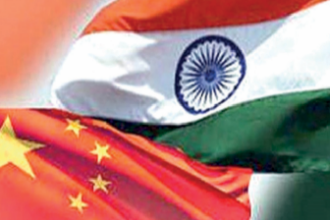
India-Canada ties have hit the rock bottom after Canadian Prime Minister Trudeau pointed fingers at the Indian government over the killing of Khalistani terrorist Hardeep Singh Nijjar. Both countries, in a tit-for-tat move, expelled diplomats and issued advisories for their citizens.
In recent months, a series of attacks targeting temples and the emergence of anti-Indian graffiti in various parts of the Western world, including Australia and Canada, have sparked apprehensions within the Indian government growing suspicions that Khalistani separatist groups may be attempting to regroup and make a resurgence in India while operating from foreign soil, most prominent of them being Canada.
Canada has a long history of sheltering Khalistani militants, who caused bloodbath in Punjab during the 1980s demanding for a separate homeland. Although a significant portion of the unrest and violence in Punjab and support for Khalistani separatists was linked to Pakistan, which provided shelter to many of them, there were a large chunk of these separatists who had taken refuge in Canada, conducting anti-India terror activities with the tacit support of the Pakistani intelligence agency Inter-Services Intelligence or the ISI. The worst terror attack conducted on any country from a foreign soil happened in the 1980s from Canada against India, by Khalistani militants, much before 9/11 happened against the USA.
In 1982, when India asked Canada for extradition of a Khalistani terrorist Talwinder Parmar, wanted in India for killing of police officers, Canada, under Pierre Trudeau, Justin Trudeau’s father, refused the request by saying, ‘India does not recognise the British queen as head of state’.
Parmar, who was the head of Khalistani terror organisation Babbar Khalsa, went on to bomb an Air India plane, called Kanishka, in 1985, which blew up mid-air off the coast of Ireland, killing all 329 people aboard. Notably, Khalistani terrorists had vowed to kill at least 50,000 Hindus. Furthermore, Parmar had threatened that Indian planes would fall from the sky and the Trudeau senior’s government remained silent.
With the resurgence of anti-India activities by the so-called Khalistani supporters in Canada has brought back the memories of the bloody eighties where Punjab was immersed in bloodbath. Naturally, Indian authorities had to act to prevent this radical group from reviving militancy in Punjab. The wounds of decade-long militancy in Punjab is still fresh.
But Justin Trudeau’s playing down the Khalistan issue, instead of stopping this menace, is due to his dependence on Sikh votes. Indian External Affairs Minister, S Jaishankar recently remarked that Canada seems to be driven by vote-bank politics over the Khalistan issue.
Canada, which has a Sikh population of more than 770,000, about 2 percent of its total population, has seen a rise in pro-Khalistan voices from its soil and Trudeau has justified it by saying his country believes in “freedom of expression”.
So, now it is clear that Canada is or perhaps has become another Pakistan, which is harbouring anti-elements and allowing them to prick India.
Pakistan’s anti-India activities since the last 75 years has left its economy almost bankrupt and stands isolated in the world. Similar fate awaits Canada. Taking cue from Pakistan’s condition, the Canadian government, instead of patronising anti-India radicals, should give more importance to salvaging its economy, which is currently sinking.
Overall, the economy shrank at a 0.2% annualized pace in the second quarter, far weaker than both a consensus estimate of 1.2% growth and the Bank of Canada’s forecast of 1.5%. That’s a deceleration from a downwardly revised 2.6% pace in the first three months of 2023. The unemployment rate in Canada was at 5.5% in August of 2023.
Canada has paused talks on the proposed Comprehensive Economic Partnership Agreement (CEPA) with India, which could boost two-way trade by as much as 6.5 billion USD, yielding a GDP gain of 3.8 billion to 5.9 billion USD for Canada by 2035, as per reports. India is the fifth largest economy in the world today.
Further, the Indian embassy in Canada has now temporarily halted visa services, which could have implications for Indian students going to Canada, who constitute the biggest share amongst the international student population there. foreign students contribute more than 15.3 billion dollars annually to the economy. This could take a big hit if the number of Indian students reduces.
In today’s unipolar world, countries have to rise above petty domestic politics and look at national interest first. The signs are already clear that the international fraternity does not care about Canada’s so-called concerns.
Neither the USA nor UK have shown any support to Canada. In fact, the West, led by the USA, is aligning with India to revive its sagging economy. Italy has announced its exit from the Belt and Road Initiative (BRI) of China. Top manufacturing MNCs like Apple Technologies have exited China and set up base in India.
Now Canada has to realise who will be the real loser in this unnecessary vote-bank tussle with India. It should align with India, instead of provoking it.