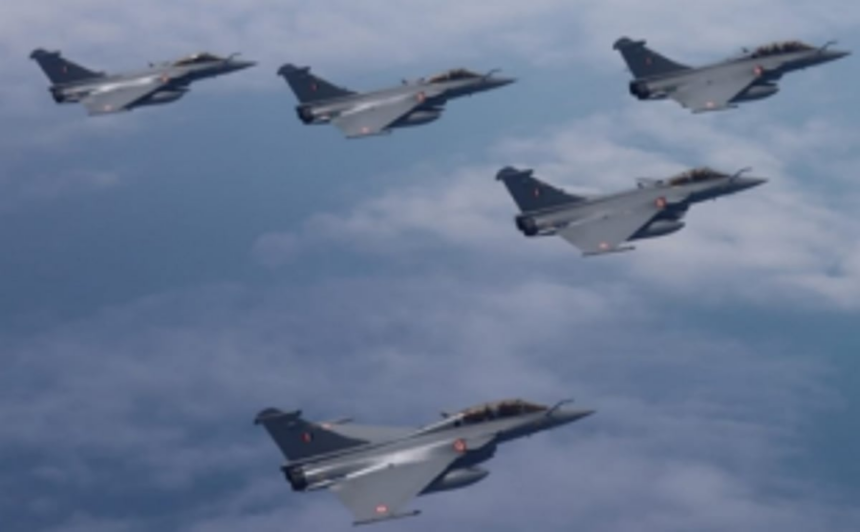
The first lot of five Rafale jets landed in India after almost two to three years of controversy involving the high costs. India has purchased 36 French Rafale fighters in a deal estimated to be worth $9.4 billion, which was signed during the period late Manohar Parrikar was the Union Defence Minister. All the jets are scheduled to be delivered by the end of 2021.
Now, that the Rafale’s have landed and controversies are history, one must understand why India critically needed the state-of-the-art technology to protect itself. India is fighting a two-pronged undeclared war with its neighbours China and Pakistan. The situation could have turned into a full-blown war last month at Galwan valley with China. More importantly, Pakistan’s F-16s and China’s J-20 fighters were considered to be superior to the Indian Air Force fleet of Su-30s, Mirage 2000, LCA Tejas, MiG-27, MiG-29 and Jaguar. However, now with Rafale, that changes.
Known for air-superiority and precision strikes, the French-made Rafales are India’s first major acquisition of fighter planes in 23 years after the Sukhoi jets were imported from Russia. With the ability to strike air-to-air targets from up to 150 km away and hit land targets 300 km within enemy territory, the Rafales are some of the deadliest fighter jets flying in the world. The aircraft are capable of carrying a range of potent weapons. European missile maker MBDA’s Meteor beyond visual range air-to-air missile, SCALP cruise missiles and MICA weapons system will be the mainstay of the weapons package of the Rafale jets.
The Meteor missile can target and destroy enemy aircraft from 150 km away. SCALP cruise missiles can hit targets 300 km away. It means that an Indian Air Force Rafale taking off from Ambala, will be able to launch one of these weapons from well within Indian airspace to hit a target deep inside another country. The MICA is a very versatile air-to-air missile with a radar seeker, an infrared seeker and it can be fired for the short-range to long-range as well right up to a 100 km. It’s already in service with the Indian Air Force is Mirages and is the primary weapon system of Rafales as well.
Dassault also touts the Rafale’s flight control system, which includes the ability to fly on autopilot in a terrain-following mode in all weather conditions. It is being now said that if India had this capability during the aerial encounter with Pakistan’s F-16 last year, after the Balakot strike, many Pakistani F-16s would have been destroyed. Also, India would never have required to enter Pakistani air space to hit targets in Balakot.
The Rafales have come at the right time for the Indian Air Force (IAF), which is facing a massive problem of depleting squadron strength. Its fleet has reduced to approximately 30-32 squadrons and the IAF wants at least 42 squadrons of fighters to be able to fight a two-front war. The maximum number of fighters IAF ever had was around 39 squadrons in the early 1990s. The squadron strength has been falling ever since. Each fighter squadron is expected to hold 18 fully operational planes plus two trainers. Some of the squadrons – especially those of the older generation MiGs – are operating with a lesser number of aircraft.
The Russian fighters MiG-27 and the MiG-21 are one of the oldest in the IAF inventory and many of these are likely to be phased out in the next five years. The IAF will phase out nine squadrons of the MiG-21 and 2 MiG-27 over the next five years. The situation was such that IAF just could not afford further shrinking of fleet size. New fighters were needed and IAF just did not have time to go through the long defence purchase process.