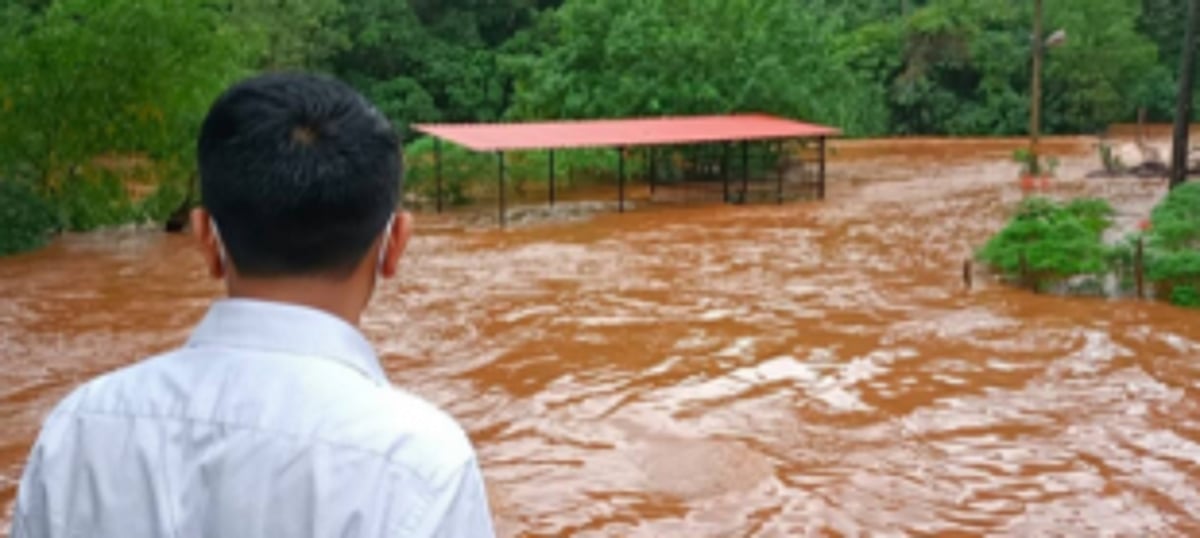
After the waters inundated the villages, the politicians went on inspection visits. Within minutes there were pictures of Ministers and MLAs wading through even knee-deep waters to get a first-hand idea of the damage that was caused by the floods. It is good to show concern and we do understand that natural disasters cannot be predicted, but there is enough of evidence to indicate that policies and actions of the governments can change the way nature responds. Had the same politicians inspected the areas before the floods and noticed changes in the environment that had been wrought about would the situation have been different?
As waters rose in the eastern talukas of Goa last week, that sinking feeling returned with a vengeance for this had been forewarned and yet everybody shut themselves to the warning. Take a short trip back in time to August 2018 when Kerala went under a flood like never before. At that time, ecologist Madhav Gadgil had said, “Certainly all sorts of problems are beginning to surface on the environmental front in the Western Ghats. Goa, of course, does not have the Western Ghats which are so high as in Kerala, but I am sure Goa will also experience all sorts of problems.” Herald had reported Gadgil’s warning which was then picked up by the media across the country. It was discussed in media and environmental circles, but it did not draw even a murmur from the political class. There was neither an agreement nor a refutation.
Gadgil’s early forecast was ignored, but the raging waters that swept eastern Goa on July 23 are evidence of what was predicted and a precursor of what can still occur at a later date. The warnings were dismissed by a silence from the decision makers, but nature asserted that it cannot be tampered with and stormed through villages displaying its fury as Goa could only look on and let the tempest subside.
Gadgil was chairperson of the Western Ghats Ecology Expert Panel, whose report was criticised for being too environment-friendly and anti-development. A member of that panel, Dr Ligia Noronha, is today the United Nations Assistant Secretary General and Head of the UN Environment Programme. If ever there was an urgency to extract the report of that panel from the depths of the government filing system where it has been consigned too, it is now. The Kerala floods of three years ago did not sound a warning loud enough for Goa to take measures. Will the floods of two days ago sound that alarm? Goa does not need to suffer the way Kerala did.
Just last month, the environmental magazine Down To Earth had analysed data for the month of June from 2010 to 2021 from various meteorological departments and found that India had received a record amount of rainfall in June 2021, excluding the 2013 rainfall. “This worked as a catalyst for the flood-like conditions in various parts of the country,” the magazine had reported warning that Goa and Gujarat were already experiencing flood-like situations. So, in essence, Goa had been forewarned about what could happen, yet did little to protect itself from what might have occurred. That it happened is indicative of just how lightly Goa takes the warnings of experts in the fields of environment.
The admission by Chief Minister Dr Pramod Sawant is that this is the most grim situation faced by the State since 1982. It has been a long 39 years since that flood and in the intervening period there have been cyclones, landslides and rising water levels, but little compares to what was just experienced. If measures are not taken soon, the experience in the future could only get worse.