Senior Bharatiya Janata Party (BJP) leaders are para-dropping into West Bengal lately. Prime Minister Modi last visited the state on the Netaji Subhash Chandra Bose 125th birth anniversary on January 23 followed by his visit on Sunday. In the recent past both Home Minister Amit Shah and BJP President JP Nadda have made visits to the State. BJP is now gauging the mood of the West Bengal electorate as senior members of the ruling Trinamool Congress (TMC) are quitting the party to join the BJP.
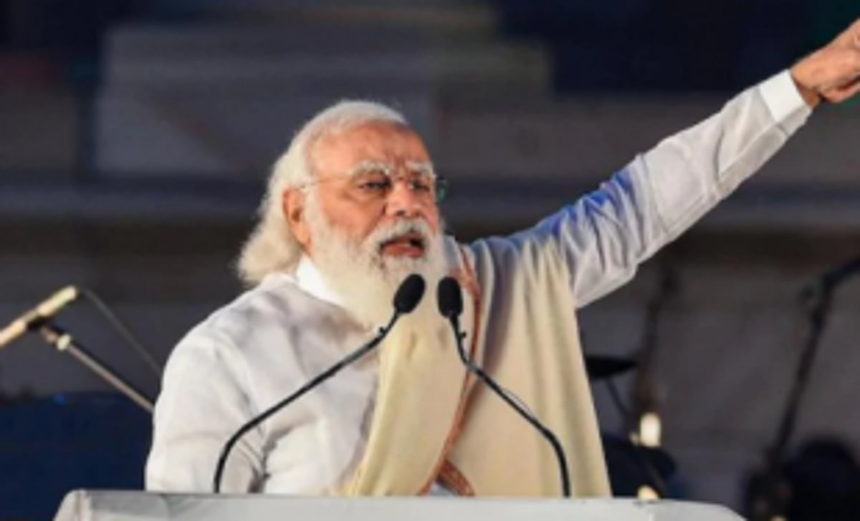
Addressing the first election rally at Haldia in West Bengal, PM Modi and launching a scathing attack on the West Bengal government, the PM said that the Mamata Banerjee government joined the PM Kisan scheme reluctantly, but the Centre is unable to transfer benefits because the details of Bengal farmers have not been provided. He said Mamata is irked if you ask her about development and chant of Jai Shri Ram, “but does not say a word at international conspiracies to defame the nation. Attempts are being made to target India’s image, but has Mamata reacted?”
Taking football as an analogy to explain to the prospective voters of BJP, Narendra Modi also mentioned that, “Bengal is the State of football lovers, so I will say this in the language of football. TMC has committed far too many fouls, the foul of corruption, the foul of neglecting the poor.” He added that, “The party of maa (mother), maati (land), maanus (human) is making farmers suffer, while you can see who is working to benefit farmers.”
Earlier Modi inaugurated a 348-km Dobhi-Durgapur natural gas pipeline and four-lane road over-bridge in Haldia stating that the LPG import terminal will benefit Bengal, Odisha, Northeast of India. He also laid the foundation stone for Catalytic Iso-Dewaxing unit at Haldia Refinery in the East Medinipur district of West Bengal and about 120 kilometres from the capital city of Kolkata. This district is considered the bastion of former TMC minister Suvendu Adhikari, who recently joined the BJP.
About fifteen years ago, such a gesture by Chief Minister Mamata Banerjee would have been considered natural. She has always been a ‘people’s leader’ and didi (elder sister), to be precise, to all. Mixing with the people in the crowd, chatting with the common people, rushing to a disturbed area to the rescue of the victims, she has done it all in a didi-like manner. Her connect with the people was unparallel, almost to the tune of Bihar’s Lalu Prasad Yadav.
Ahead of the upcoming assembly elections in the State in April-May this year, many, especially the opposition, is drawing various conclusions out of the chief minister’s gesture. Some consider it as wooing the Adivasis, Schedule Tribe voters in North Bengal, who did not elect any TMC parliamentarian in the 2019 Lok Sabha elections when BJP got 18 of the 42 Lok Sabha seats.
Some experts in West Bengal feel that she has been targeting 84 out of 294 assembly constituencies dominated by the SC and ST communities. Mamata has also to look after the 30 per cent Muslims in her State which is being attempted to be wooed away by Hyderabad Asaduddin Owaisi’s AIMIM leader. It is time to hold on to many strings when her own party members are leaving and jumping the fence to join BJP. Meanwhile, a cleric, Abbas Siddiqui has announced an Indian Secular Front to consolidate the Muslims and Dalits in West Bengal. The meteoric rise of Mamata’s nephew Abhishek Banerjee is also leading to unrest in her own party.
The churning over identity-politics in Bengal has been absent for long. Historically, Bengal has seen bitter rivalry between the Hindus and the Muslims in the years leading to independence in 1947. Riots in Noakhali are well recorded in post independent India. The difference in the two communities brewed during the British Empire rule and intensified since the proposed partition of Bengal in 1905. Also the partition of Bengal on religious line in 1947 and exodus of the Hindu refugees from the then East Pakistan after the partition created a perfect platform for polarising identity politics.
With Congress likely to partner with Communist Party of India (Marxists) – CMP, which now has depleted a lot in their political stature, the direct fight is between the TMC and BJP. While TMC faces an anti-incumbency of a decade, BJP is trying its level best to make a dent in the State after its “success” in 2019 Lok Sabha elections and the spate of TMC senior members joining their party.