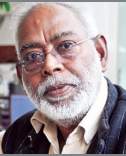
Everybody who is anybody has tweeted and congratulated Abhijit Banerjee, the Indian-born economist from MIT who has won the 2019 Nobel Economics Prize, along with his French-American wife Esther Duflo and Harvard professor Michael Kremer. In a world where India is starved of Nobel laureates, it has always been quick to claim as it own any of the winners who are Indian born, and Banerjee, who was born and also studied in India, is just one of them. Interestingly, the trio gets the Nobel for their experimental approach to alleviating global poverty. The best compliment to the Nobel winner would be if India, which has a large population living in poverty, would apply Banerjee’s approach to much further levels so as to put an end to poverty permanently.
President Ram Nath Kovind has said that the research by the trio has helped economists better understand how to fight poverty in India and the world, while Prime Minister Narendra Modi said that Banerjee has made notable contributions in the field of poverty alleviation. That’s not all, but the Delhi government’s education reform scheme ‘Chunauti’ to put a check on dropout rate of students, was also inspired by Banerjee’s work, Delhi Chief Minister Arvind Kejriwal said. What also comes as a surprise is Congress leader Rahul Gandhi stating that Banerjee had helped the party conceptualise its ‘Nyay’ scheme that the party had gone to the polls earlier this year and which was to help remonetise the economy. Well, Congress did not come to power, and the Nyay scheme will not see the light of day, but can India approach this differently?
There is much for India to learn from the economics Nobel winners in fashioning policies for the country. The Royal Swedish Academy of Sciences said the research by the trio has considerably improved the world’s ability to fight global poverty. “In just two decades, their new experiment-based approach has transformed development economics, which is now a flourishing field of research,” the Academy stated, before adding that, “As a direct result of one of their studies, more than five million Indian children have benefitted from effective programmes of remedial tutoring in schools. Another example is the heavy subsidies for preventive healthcare that have been introduced in many countries.” So the experiment has already yielded certain results in India, isn’t it time to push it further? The fight against poverty has won a Nobel, and it’s not the peace prize. So it’s time to gain some victories.
The fight against poverty is neither simple, nor easy, but these Nobel laureates have given the battle some direction. A few questions the Banerjee asked in the book ‘Poor Economics’ are those that have to be asked again and again and answered. ‘Why would a man in Morocco who doesn’t have enough to eat buy a television? Why is it so hard for children in poor areas to learn, even when they attend school? Does having lots of children actually make you poorer? Answering questions like these is critical if we want to have a chance to really make a dent against global poverty,” Banerjee had written. And these are indeed questions that have to be asked.
India also needs to listen to Banerjee when he speaks of the economy. According to him, the Indian economy is on shaky ground, with the data currently available not holding any assurance for the country’s economic revival anytime soon. He is not the only one to say this, or something like this. But he goes further, when he says that though in the last five-six years there could be some growth witnessed, ‘that assurance is also gone’. The economists are speaking, India needs to listen.