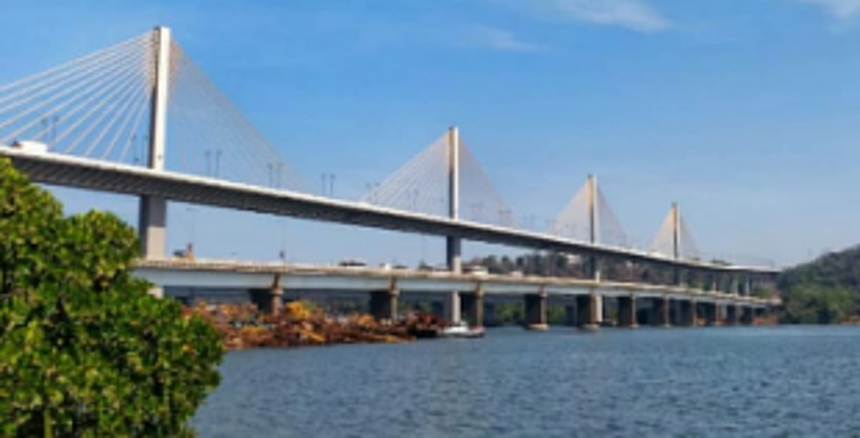
In its third year and the third monsoon it has weathered the Atal Setu, a cable-stayed bridge that was inaugurated with much fanfare and was tagged to be a wonder in the State, has already developed faults that have necessitated its closure for 100 days to undertake repairs. Exactly 30 months after it was thrown open it has been closed for three months, forcing traffic to be routed via the two old bridges that have shown more resilience than the new one that has emerged between them. Unbelievable as it may sound, it is true and we are left to wonder at the turn of events rather than at the bridge.
Goa State Infrastructure Development Corporation (GSIDC) under whose watch the bridge project was taken up, is playing down the issue stating that the potholes that have been occurring during the monsoon are not related to the quality of the work. The reason for the potholes, according to GSIDC, is the failure of bonding of bitumen and water proofing layers. The craters are increasing in size due to the stagnation of water and running of vehicles. Since the potholes have sprung up during the monsoon, the corporation believes that this could be due to the proximity of the bridge to the coast, the climatic conditions and incessant rains.
This may be so, but then it is indeed strange that these unique climatic conditions of the State were not taken into consideration at the time of planning the bridge or even during the construction stage, when changes could have been made. At least five monsoons went by during the years it took to build the bridge. Didn’t the possibility of potholes occur to the builders and consultants? The bridge was undertaken at a cost of over Rs 860 crore, and are we to believe that the climatic conditions were not factored into the design? If this is so, it amounts to negligence and those responsible have to be held accountable. There is no excuse that can be made for this. Don’t engineering students learn that the local climatic conditions are a major factor in designing?
The emergence of the potholes has forced the Goa State Infrastructure Development Corporation to rope in the Indian Institute of Technology, Chennai, to study the issue and find a long-term solution to the problem. Once the solution has been found, Larsen & Toubro, the company that built the bridge, will be asked to undertake corrective measures as per the five-year defective liability clause. A question here: if the fault is not due to the quality of work, can the defective liability clause be invoked? The faults with the Atal Setu cannot be taken lightly. It was constructed with public money, which means there has to be accountability and responsibility attached.
Another apprehension is that a similar problem could arise on the under-construction eight-lane Zuari bridge, as this one too will have a similar coating as per the guidelines of the Ministry of Road Transport and Highways (MoRTH), New Delhi. If the State has special climatic conditions, shouldn’t it bring this to the notice of the Union Ministry and explain that the design will not suit the local conditions? Goa now depends on IIT Chennai on finding the right solution to the problem.
There is also the other problem of sinking approach roads for which a permanent solution needs to be found. Atal Setu appears to be causing a lot of distress to the authorities. The investment on the bridge was huge. The cost of the fixtures was also under the scanner. Is it that there were issues during the construction stage that were overlooked? A new bridge should not have given problems of such a nature.