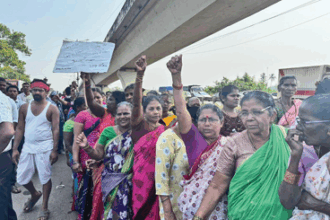
As the incessant people’s protests over the greater Panjim PDA show no signs of abetting with the newly constituted “Goenkars Against PDA (GAP) consisting of villagers of St Cruz and St Andre, it is apparent that the ‘gap’ between people and government can be narrowed if the, basic tenet of village planning is followed, i.e villages should be removed from PDAs.
If TCP Minister Vijai Sardesai is willing to take that plunge and ensure that all village areas are dropped from the Greater Panjim PDA, it will set a major precedent, which all other PDAs will have to follow. That will be the only way to protect our fragile villages from the march of rampant urbanisation.
Constituents of St Cruz and St Andre constituencies, under the banner of Goenkars Against PDA (GAP), have demanded a concrete assurance from TCP Minister Vijai Sardesai that the Greater Panjim Planning and Development Authority (GPPDA) will be de-notified and have decided to go ahead with the protest on April 6.
While that discussion can go on, wasn’t the basis of the agitation, the removal of village areas from the PDA. The fight was against our pristine village areas trampled by concrete and anti-village development. The fight was to ensure that Goa doesn’t have more urban Calangutes and Bagas, absolutely destroying the look and feel of the land. And that should be the good fight. And the villagers of St Cruz, St Andre, Bambolim-Curca, Azossim-Mandur and Gancim-Batim should hold this fight close to their hearts as they are already winners.
The town and country planning (TCP) department’s sub-committee formed to look into the concerns surrounding the constitution of the Greater Panjim Planning and Development Authority has recommended the removal of Azossim-Mandur and Gancim-Batim villages from the Greater Panjim PDA.
But there’s one more step that needs to be taken. All village areas need to be dropped from the PDA. That is the only way the sanctity of Goan villagers can be protected.
The reduction of FAR from 80% to 60% is a positive step towards the low density high cost formula. Village development therefore has to follow the low density approach through which our land our spaces, our farms and our skyline can all be protected.
This has to be the Goa model of development. This is the only model which can prevent Goa from becoming another Haryana, a comment for which the TCP minister got a lot of flak. But if “Haryana” is taken to mean any state which has seen a rapid pace of urbanisation from its hitherto rural status, then it won’t be out of place to say Goa fits the bill.
There is another factor which is at play here. The anger of most of the villagers of the Greater Panjim area appears to be the re-emergence of Babush Monserrate at the helm of affairs as the Chairperson of the new PDA. People’s angst against such bodies headed by politicians who need to be accommodated, rather than by experts in holistic land planning, is genuine. The people of Goa need to be assured that their land is not at the mercy of land sharks, but those who have in mind the development of Goa, in sync with the nature of the land and needs of its locals.