Whether it will be through the help of external forces from China, Russia or even Pakistan, the question remains unanswered. With many ‘influential’ countries virtually backing out, Afghanistan is left alone to fend for itself with no external help as of now. Yes, the United States of America has been squarely blamed for this ‘withdrawal’ from Afghanistan which led to this chaos in the country where the future is under dark clouds.
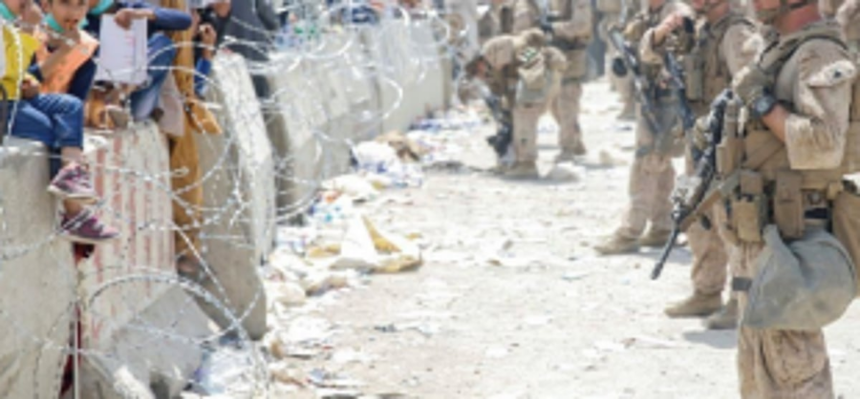
Two decades ago, mission Afghanistan seemed direct, clear and just. It was an effort to invade Afghanistan and pursue, capture or kill Osama bin Laden, mastermind of the 9/11 worst terrorist attacks on the USA. Achieving that goal also included overthrowing the Taliban, and steadily the mission morphed into a vast, complicated experiment to reshape a society that few Americans understood. After a war stretching over four US Presidents and costing more than a trillion dollars and tens of thousands of lives, the once-routed Taliban has retaken power in a swift march across Afghanistan, barely meeting resistance, occupying the presidential palace and driving the remaining US troops to a single redoubt: an airport now swamped with desperate Afghanis to flee their own country due to fear of the Taliban.
For years, Bin Laden’s Al Qaeda terrorist network thrived in Afghanistan under the Taliban, which then ruled most of the country. Shortly after Al Qaeda attacked the US on Sept 11, 2001, killing nearly 3,000 people, Bush dispatched American troops to Afghanistan to hit the terrorist group where it lived. It took a decade to finally take revenge by killing Osama Bin Laden in 2011 close to the capital Islamabad in Pakistan. Today, military officials and analysts believe the threat from Al Qaeda has diminished but has not vanished. Al Qaeda franchises have sprung up in parts of Africa and other countries, where they did not operate previously. Moreover, according to the United Nations, the Taliban never completely severed its ties to Al Qaeda, despite its pledge to do so.
Donald Trump started with a strong ‘disastrous’ hand and following him Joe Biden played it in the worst manner possible. Trump bestowed the Taliban with political recognition by directly negotiating with the group, sidelining and forcing the Afghan government to free more than 5000 Taliban fighters from prisons. Biden put the final nail in the coffin of the Afghan government and army by the so-called ‘orderly withdrawal’ of US forces, which the Americans call ‘Marines’. Apparently, the USA has believed that the Taliban would go against the interests of the USA and would not let Afghan soil be used against the Americans. The USA still believes that Afghanistan will not harbour Al Qaeda, and will be ‘softer’ than in the 90s – when they were ruling the country – on women and human rights. Most probably, behind the closed doors of so-called peace negotiations in Qatar, there has been more ‘give and take’ between the USA and the Taliban, yet to be revealed to the world and declassified.
The USA interest was clear-cut: to end its longest war and ‘bring the boys home’ at any cost, including dealing with the Taliban. Pakistan, on the other hand and for a long time, has played the cards of ‘Taliban’ and ‘fighting extremism’ for the sake of USA financial benefits. Pakistan has for long defined its Afghanistan doctrine to counterbalance its sworn enemy, India, especially after the abrogation of Article 370 and 35 A from Jammu and Kashmir. Islamabad would adopt further support of the Taliban if need be. That is why the peace in Afghanistan is dependent on reconciliation between two nuclear neighbours, India and Pakistan.
On the other hand, Russia, China and Iran enjoyed showcasing the diminishing USA influence in the region by hosting some of the Taliban’s leaders in Moscow, Beijing and Tehran. With a lessening USA influence and withdrawal of USA Marines from Afghanistan as well as the weakening government in Kabul, all three allies saw an opportunity with the Taliban. Indeed, the anti-American alliance of Moscow-Beijing-Tehran contributed to the downfall of Kabul by the implicit endorsement of the Taliban. All three countries’ embassies are functioning now in Kabul while many others have evacuated their staff. It is also an opportunity for China to play on its cards of “expansionism”.
The international geo-politics is rapidly changing in the region while it is also a big opportunity for India to emerge as political and military heavyweight in the region. However, New Delhi is pussyfooting in these crises, while strengthening and reinforcing its security, especially in the north western sector, including at borders with China and Pakistan.