

Maria Augusta Elvira de Sousa is lost to history. She wanders its corridors, unclaimed. In accounts by European chroniclers, her ethnicity remains a shadowy unknown to be guessed at, presumed most likely to be a Portuguese woman. But I am determined to reclaim Elvira’s rightful place, because Elvira was a Goan.
In March 1896, the Zanzibar Gazette announced the engagement of Elvira de Sousa to James Martin. Elvira was 19, Martin was 39. She was the eldest daughter of Dr Augusto Bras de Sousa, who had arrived in Zanzibar in 1881. In 1870, Bras had joined Grant Medical College, Bombay, as a military pupil in the subordinate branch of the Indian Medical Service. He passed his examination in 1874, and was appointed as Assistant Surgeon to the European Military Hospital of Colaba. While in Zanzibar, he became the first Goan to represent Portugal on the island, as vice-consul in 1885, and appointed consul-general in 1892. For many years, he was an agent for the shipping line, Mala Real Portuguesa.

Elvira’s fiancé, James Martin, for all purposes was considered British, and deeply embedded within Britain’s imperial administration, but he was in fact, a Maltese sail-maker, who found fame as a much sought-after guide to explorers and organiser of caravans. At the time of his wedding, he was leading caravans into the African mainland of 500 to 800 men, and earning anywhere between £2000-3000, trading in ivory. Martin’s inability to read and write was ameliorated by a privately hired Goan clerk, Anacleto de Silva, who undertook all his correspondence for him. We cannot glamourise what Martin’s job entailed. Caravan leaders were known to be brutal; a caravan journey with hundreds of men into Africa’s interior was fraught with deprivation; desertions were common and discipline was enforced with flogging.
The wedding took place in April, 1896, at the British Agency, the equivalent today of the British embassy. With both the bride and groom, well known in Zanzibar, the streets leading up to the Agency were decorated with palms and bunting. After the ceremony, the couple returned to the bride’s house, where ‘all Zanzibar assembled’ to congratulate them. Over 500 invitations had been sent out. The Sultan’s Goan band ‘played with a suitable fervour’. In the drawing room, the presents were tastefully displayed, and in the dining room, an ‘Eiffel Tower of a cake’ sat on a table. A description of the bride’s dress is given by a guest: the ‘underskirt was of white satin, veiled with cream Indian silk gauze, handsomely embroidered, the front of the bodice being also very prettily draped with the same and having a deep square collar trimmed with lace.’ She wore a white tulle veil and a small coronet of orange blossom gifted by her Highness the Sultana. Her ornaments were diamonds.
How did Elvira adjust to her husband’s world of European administrators colonising East Africa? We know so little about Elvira. A mention here and there in the newspapers or personal journals of the 1800s, which I’ve pieced together, portray Elvira to be a high-spirited girl, willing to accompany her adventurer husband into Africa’s punishing interior. Soon after the wedding, in July 1896, Martin left for Kenya and Elvira accompanied him up to ‘Kikuyu’. Kikuyu was not so much a region but a tribe of Kenya, who lived predominantly around what is now the city of Nairobi, but which back then had not yet been founded.
Martin and Elvira travelled to Fort Smith and Ngong in Kenya, where Martin introduced his bride to the small contingent of European colonists camped there as settlers and officials. On colonial maps of this era, this area is named ‘Martin’s camp’. Ngong Fort became Fort Elvira, named in honour of Elvira de Sousa. She entertained the Europeans playing the organ and singing in several languages. Everyone remembered Elvira as the Portuguese lady.
The Kenyan interior was relentlessly inhospitable without any of the creature comforts, Elvira would have been used to in Zanzibar. A visitor, Vialle, to the outstation in Kibwezi, in November of 1896, observed that Elvira and Martin, lived there quite comfortably, having ‘the best house on the station.’ The guest came upon 1500 Kikuyu workmen cutting down trees to build an embankment. The workmen were under Martin’s charge, and his most difficult job was providing food for them. Vialle noted that, ‘Mrs Martin seems quite happy and contented. She has a very well laid out garden in front of the house and a large vegetable garden at the back.’ Elvira, it seems had, at least on the face of it, made the best of it. In 1899, Elvira and Martin baptised their daughter Nina Eldoma at Eldoma Ravine station, after which they celebrated with port and wine, and Elvira played on the piano.
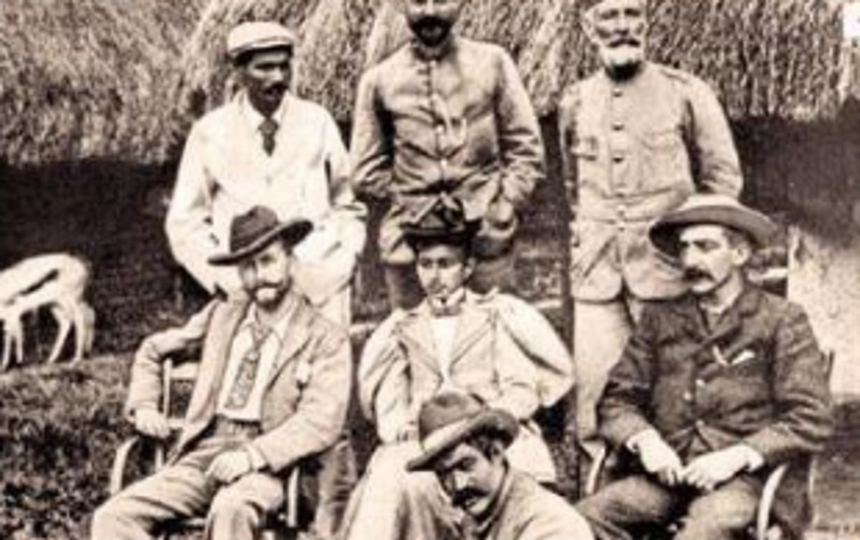
I located from the ‘Winterton collection of East African photographs’ archived at Northwestern University, USA, a photograph of Martin and Elvira, taken between 1907-1914. By then, they were living in Mabira, Uganda. Elvira sits smiling amidst four European colonials, outside a bungalow, a playful dog at her feet. This scene of congenial integration belies the racism, Asian and African populations endured at the time. What Elvira herself might have endured, we have no record of, but the society which emerged in Zanzibar at the turn of the 19th century, is an important branch of study. Here, we have evidence of a Goan community which crossed racial barriers and in many ways, subverted racial hierarchies of European superiority, not through protest but through the curious circle of influence they exerted during this era of ‘high imperialism’.
(The writer is the author of Goan Pioneers of East Africa)



