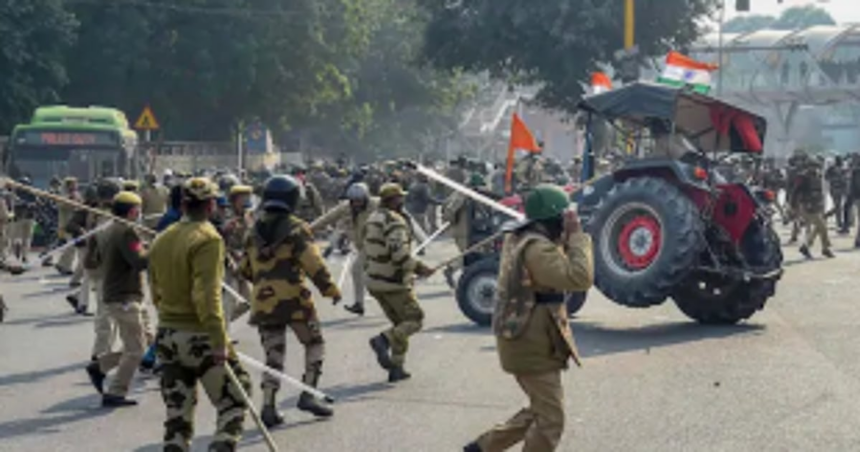
After two months of peaceful protests, 11 rounds of talks with the government, a Supreme Court order that stayed the implementation of the contentious farm laws, the protesting farmers had gained the sympathy of a vast majority of the people. In one instance, the violence on Republic Day in New Delhi has cast a dark shadow over the farmers protests and in addition weakened the movement considerably. That the farmer leaders had to distance themselves from the violence even as it was unfolding in the National Capital speaks volumes about how quickly the leadership realised that the farmers who broke ranks and went on a rampage were damaging the cause. They hurried to denounce the ‘anti-social elements’ who they claimed had ‘infiltrated the otherwise peaceful movement’ terming the violence ‘undesirable and unacceptable’. Two farmers’ groups walked out of the protest a day after the violence.
What occurred in New Delhi on Republic Day was ‘undesirable and unacceptable’ and much more. It has to be condemned. The Red Fort is where on August 15, 1947 the Indian Tricolour was hoisted signalling the Independence of India. On the country’s Republic Day that fort can have space for no other flag. The Red Fort is a revered symbol of Indian nationhood and storming it is unacceptable. But if indeed, the protest movement was ‘infiltrated’ by ‘anti-social elements’, then this has to be investigated. The movement is important, and it cannot be allowed to be highjacked by any other group, if at all.

The point of contention of the entire issue is that the new farm laws that permit the sale of agricultural produce in the open market are not acceptable to the farmers who for years have been assured of a minimum support price from the government for their crops. This minimum support price gave them the confidence to invest in another crop, without fearing of any drop in the market prices. The farmers believe that the new laws, as market forces will come into play, could see them being exploited by corporates and so lead to fluctuations in prices that could adversely affect them depending on the produce in certain years.
Politically, if the farmers’ protests were to continue, they would not be conducive to the government. The opposition parties were almost all supporting the farmers at the protest site since the time the laws were passed. This too changed on Republic Day. Nationalist Congress Party leader Sharad Pawar, himself an agriculturist, said that what occurred was indefensible, though he went on to say that the reasons which led to the situation could not be ignored. Others have described it as most unfortunate, unacceptable and condemned it. Almost all have blamed the Centre for allowing the situation to deteriorate to this level. BJP spokespersons have asked what the farmers, till that day called food providers, should now be called. The bane in the protest has been the politics involved. But the farmers are a big votebank in the country and politics would definitely percolate into the movement.
A reason why the farm laws drew such huge support is precisely because of the sheer numbers of them, and that the Indian economy is still largely agrarian and the primary source of livelihood to over half the population of the country. The farmers had been protesting with that numerical strength, but will now be negotiating with the government from a very weakened position. It all changed in one evening and the farmers – unless it is proven that the movement was infiltrated – have nobody else to blame but themselves. The movement will take a new turn from now on, with the strength of the farmers severely dented.