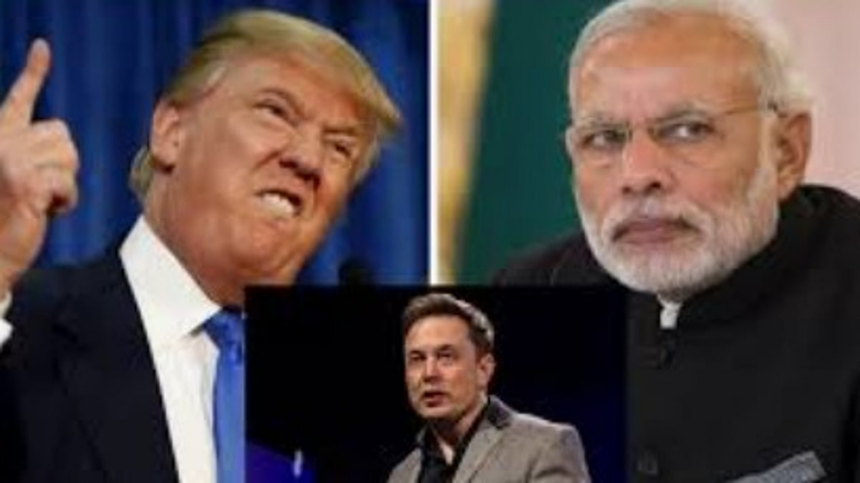
In the world of political spectacles, few recent incidents have sparked as much outrage as the claims surrounding a $21 million US government grant intended for “voter turnout” in India. The firestorm was ignited by a social media post from Elon Musk’s Department of Government Efficiency (DOGE), which suggested that USAID (the United States Agency for International Development) had allocated millions of dollars to influence India’s elections. The claim quickly gained traction, fuelled by none other than President Donald Trump himself, who used the opportunity to attack both USAID and its foreign aid initiatives.
At the heart of this controversy lies a masterful mix of miscommunication and political manoeuvring. In its original post, DOGE falsely asserted that USAID had canceled a $21 million grant for “voter turnout in India” as part of President Trump’s broader cuts to foreign aid. The idea of foreign governments meddling in another nation’s democratic process – especially when it involves the US – is, of course, a serious accusation. Yet, as investigations soon revealed, there was no such grant intended for India in the first place.

Documents accessed by the Indian Express and reports from The Washington Post exposed the truth: the $21 million in question was not directed toward India’s elections, but instead, to a non-profit organization supporting political engagement in neighbouring Bangladesh. Despite this clear evidence, the claims made by Musk and Trump had already stoked significant unrest in India, especially among the ruling BJP and its supporters.
The suspicion of foreign interference has given the BJP perfect scope to amplify the accusations. For years, the BJP has accused international civil society organizations and human rights groups, accusing them of attempting to undermine India’s sovereignty. This latest incident was swiftly seized upon as proof that foreign actors were trying to interfere in India’s internal affairs, specifically by targeting the country’s election process. Amit Malviya, head of the BJP’s IT cell, proclaimed that Trump’s claims confirmed an attempt to “influence the Indian election and install someone other than Prime Minister Modi.” Meanwhile, other prominent BJP leaders, including Vice President Jagdeep Dhankhar and Foreign Minister Subrahmanyam Jaishankar, voiced their deep concern about the alleged interference.
However, the reality was that these claims were entirely unfounded. The $21 million mentioned in the DOGE post was part of a much larger funding initiative for Bangladesh, not India. The Washington Post reported that US officials were as puzzled by the claim as anyone else, stating that no such program had ever existed in India. In fact, USAID had not funded any electoral-related programs in India since 2008. As a result, both the Indian Express and The Washington Post have thoroughly debunked the allegations of foreign interference in India’s democratic process.
Yet, the impact of these claims has been significant, particularly in the political landscape of India. The allegations served as a perfect tool for the BJP to accuse the Congress party of being complicit with foreign powers. Congress, on its part, used the opportunity to fire back, accusing the BJP of spreading “fake news from America” to discredit the opposition. Congress spokesperson Jairam Ramesh described the incident as a “comedy of errors,” emphasizing that the BJP had been quick to jump on a completely false narrative.
Trump continued to echo the false claim at multiple events, going so far as to suggest that the funds were intended to “get somebody else elected”. What’s more troubling, however, is the role of social media and its ability to rapidly spread misinformation. Musk’s X platform (formerly known as Twitter) has become a breeding ground for political claims, and DOGE’s influence, paired with Musk’s own public support of Trump’s positions, created a perfect storm. Musk has even taken to boasting that DOGE is “feeding USAID into the wood chipper,” further legitimizing the baseless accusations.
Meanwhile, some members of India’s civil society expressed concern about the longer-term consequences of the controversy. Fears grew that the BJP might use the allegations of foreign interference as a pretext for further cracking down on non-governmental organizations and foreign-funded projects in India. After all, the government has already made it difficult for certain international organisations, such as Amnesty International and Greenpeace, to operate freely within the country.
What this saga highlights, above all, is the peril of unchecked political rhetoric in the digital age. The manipulation of facts—whether intentional or not—can have significant consequences, not only within the borders of the country in question but also on a global stage. In India, where both national pride and electoral politics are deeply entwined, misleading claims of foreign interference risk further eroding trust in both domestic institutions and foreign relations.