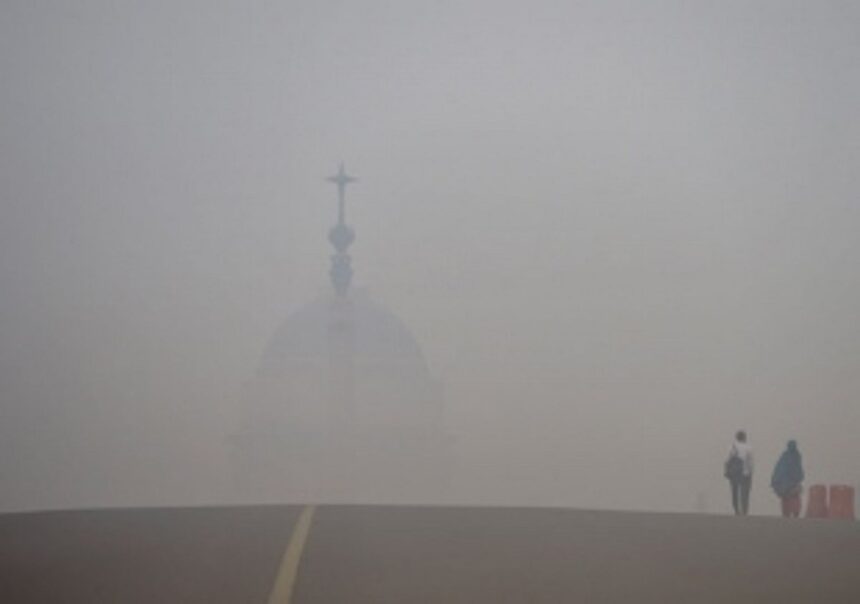
Delhi continued to reel under a severe air pollution crisis on Sunday morning, with the Air Quality Index (AQI) recorded at 439 at 7 am, according to data from the Central Pollution Control Board (CPCB). The situation worsened overnight, as the AQI stood at 432 at 10 pm on Saturday, remaining in the ‘severe’ category before deteriorating further by early Sunday.
The persistent smog raised serious health concerns, particularly for children, the elderly, and people suffering from respiratory or cardiovascular conditions. Several parts of the city reported alarmingly high pollution levels, underlining the widespread nature of the crisis.

Anand Vihar recorded an AQI of 489, followed by Ashok Vihar at 463, Bawana at 467, Chandni Chowk at 464, Dwarka Sector 8 at 469, ITO at 448, Narela at 412, Punjabi Bagh at 476, RK Puram at 467, and Wazirpur at 478. All these locations fell in the ‘severe’ category, indicating extremely poor air quality and heightened health risks.
As per AQI classification, readings between 0 and 50 are considered ‘good’, 51 to 100 ‘satisfactory’, 101 to 200 ‘moderate’, 201 to 300 ‘poor’, 301 to 400 ‘very poor’, and 401 to 500 ‘severe’.
Visibility across Delhi remained poor due to cold wave conditions, with dense fog covering large parts of the city. The India Meteorological Department (IMD) reported moderate fog at several places and dense fog at isolated locations. Minimum temperatures ranged between 5°C and 7°C, around 1.6°C to 3°C below normal.
In response, the Commission for Air Quality Management (CAQM) reinstated Stage-IV measures under the Graded Response Action Plan (GRAP) across Delhi and the National Capital Region (NCR) on Saturday to prevent further deterioration in air quality.