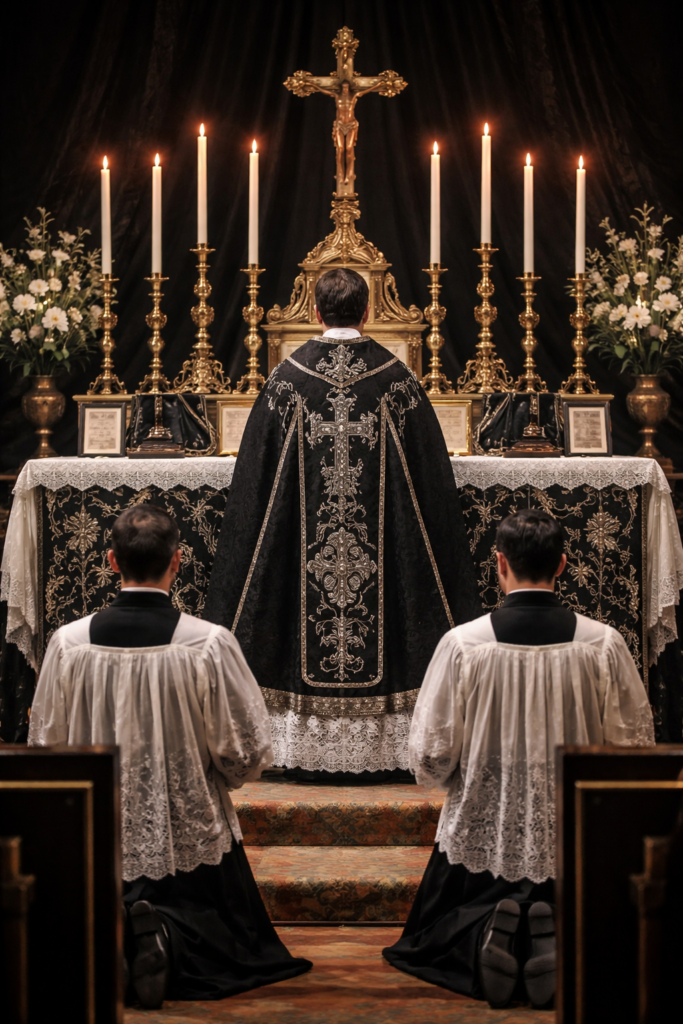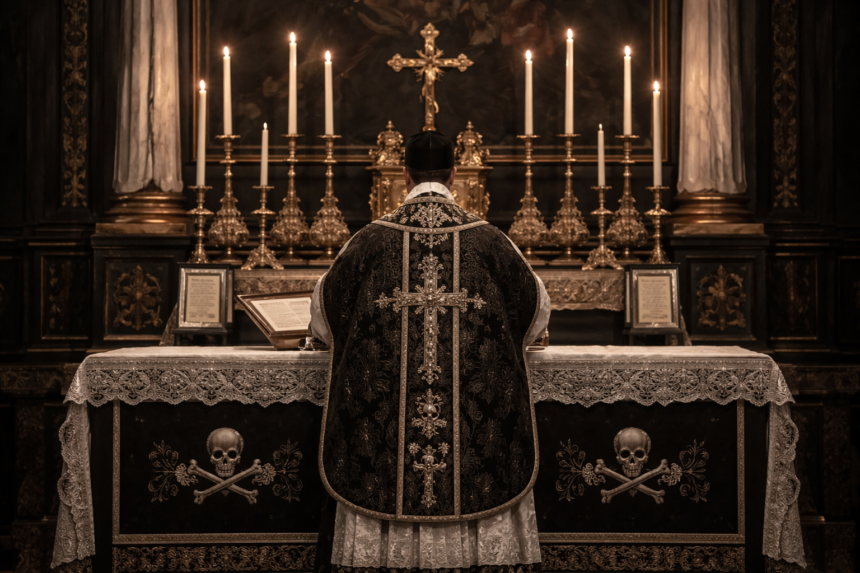
In the sacred tapestry of Christian liturgy, vestments have evolved from the flowing robes of ancient Roman elites to the dignified chasubles that drape priests during Mass. These cloths, prescribed by Church norms, serve a profound dual purpose: they illuminate the liturgical seasons, guiding the faithful through their spiritual odyssey, and spotlight pivotal mysteries of faith, like Christ’s passion or resurrection. Liturgical colors, violet for penance, white for joy, green for hope, red for the Spirit’s fire, gold for glory, black for mourning, rose for anticipation, and even blue in some traditions, evoke the moods of the Church’s calendar, adorning both vestments and altar hangings.
A subtle distinction endures: the seasonal hues of Mass vestments contrast with choir dress, which remains steadfast across the year, save rare exceptions.

The Timeless Symbolism of Black
Once a cornerstone of solemnity, black vestments graced All Souls’ Day, funerals, and Requiem Masses, as well as the penitential veils of Advent, Lent, and the Exaltation of the Holy Cross. Even in the Novus Ordo Missae post-1965, black endures for these, though Good Friday now favors red (recalling the Passion), which is often preferred in modern practice. No barrier prevents a priest from reviving black for All Souls’ or funerals, honoring its ancient roots. Yet, surprisingly, while generations know violet’s somber shade, many have never glimpsed black’s profound depth.
Black whispers not generic grief, but a focused lament for the departed, urging prayers for their souls. White celebrates triumph; violet mourns personal sin through penance. Black, by contrast, turns our gaze outward, to the dead, not ourselves, making it exquisitely apt for funeral Masses, Requiems, and All Souls’. These rites prioritize the deceased: prayers plead forgiveness for their sins and temporal punishments, thus drawing one’s attention on the fact that funerals serve the soul in purgatory, not merely the living’s solace. Theologically, white or purple falters here; black’s austere tone evokes sin’s shadow (original and personal), death’s intrusion via the Fall, purgatory’s reality, and our duty in the spiritual works of mercy: praying for the dead.
Black vestments during Lent symbolize profound mourning and penance, echoing the somber journey toward Christ’s Passion.
They represent death to sin and human mortality, urging believers to confront spiritual realities with humility.
Worn sparingly in some traditions, black evokes the gravity of sacrifice and the hope beyond resurrection.
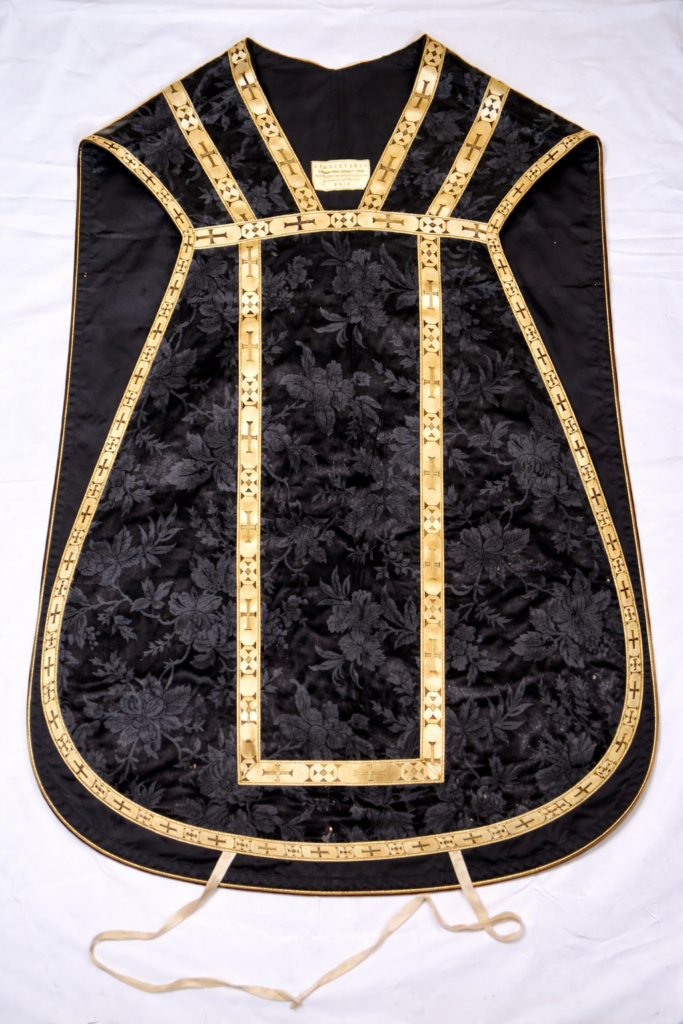
An enhanced image of a black Chasuble from a private collection in Margão, Goa
Liturgical Shifts After Vatican II
Post-Vatican II reforms reshaped these norms. Canon 1780 of the 1983 Code of Canon Law affirms: “the traditional way of using vestments in colors should be preserved: white, red, green, purple, black, as well as, depending on the circumstances, pink and blue.” Yet black faded, yielding to purple in funerals, symbolizing grief laced with resurrection hope. Vatican directives permitted this, shunning black’s perceived gloom.
This shift mirrors broader trends: the 1970 General Instruction of the Roman Missal (GIRM) allowed white for funerals to emphasize resurrection, accelerating black’s decline. In Goa, once vibrant with the Latin rites blending Iberian and Indian influences, black vestments vanished decades ago eclipsed by purple amid post-conciliar optimism and local syncretism. Today, almost none of the Goan parishes recall its use, rendering the tradition “dead since long” in this coastal cradle of faith.
Indeed, the black chasuble endures, its role refined yet vital. Modern tailoring renders it as elegant as antiquity’s weaves, its symbolism, mourning, penance, purgatorial hope, timeless. In Goa’s sunlit churches, its revival could stir souls, bridging eras.