Team Herald
PANJIM: February 4, 1987, marked the day Konkani was declared the official language of Goa, but even 38 years later, the debate over script recognition for Konkani literature continues to simmer, with activists questioning Sahitya Akademi’s decision to award only Konkani books written in Devanagari, but not in Romi.

Former Speaker and Konkani advocate Tomazinho Cardozo highlighted that while the Sahitya Akademi only recognises Konkani books in Devanagari script for its awards, this wasn’t always the case.
“In the past, books in various scripts were considered,” Cardozo
explained.
“However, in 1983, the advisory committee, dominated by Devanagari writers, decided to exclusively accept books in Devanagari for the awards, effectively side-lining works in Romi script.”
Former president of the Dalgado Konknni Akademi, Premanand Lotlikar, suggested the decision was part of a deliberate effort by the Devanagari lobby to marginalise Romi script literature.
“They claimed that books in Romi script lacked standardisation,” Lotlikar noted. “Yet, when Jess Fernandes’ Romi book was accepted after transliteration, it was awarded the Sahitya Akademi prize. The Romi script has historically played a pivotal role in preserving Konkani — particularly among the Catholic community. I strongly believe that Konkani written in both the scripts should be preserved.”
Global Romi Lipi Abhiyan president Kennedy Afonso criticised the Akademi’s policy, arguing that the ‘one language, one script’ approach disregards the rich history of Konkani written in Romi and Kannada scripts.
“The Sahitya Akademi was founded to promote literature in all Indian languages, including those in diverse scripts. By focusing solely on Devanagari, it neglects works in Romi and Kannada, both of which hold deep cultural significance for Konkani speakers,” Afonso stated. “Other scripts should be acknowledged without the requirement of transliteration into Devanagari.”
Anant Agni, headmaster at Ravindra Kelekar Dnyanmandir and a prominent Konkani writer, defended the Sahitya Akademi’s stance, citing a policy that awards literature in a single script per language.
“Devanagari is the natural script for Konkani, and I feel the awards should be given only for the Devanagari script,” Agni asserted. “While Romi and Kannada works are occasionally transcribed into Devanagari, it is important to note that this process has helped include works from both scripts in the award process. The Goa Konkani Academy and Konkani Bhasha Mandal have a provision related to literature, by which they can transcribe books in either the Kannada script or Romi Konkani script to Devnagari, which are then eligible for the Sahitya Akademi awards.”
Konkani writer Michael Gracias emphasised that the debate over script should not overshadow the importance of promoting the Konkani language itself. “Scripts are simply tools to promote language,” Gracias said. “The Devanagari lobby’s tactics are suppressing the diversity of Konkani literature. Romi script played a central role in the language’s history, with the first periodicals and newspapers being published in Romi, and even major figures like Shenoy Goembab writing in it. The Sahitya Akademi’s refusal to recognise Romi is an injustice to this history.”
Vasco-based writer Ashok Chodankar lamented the ongoing exclusion of Romi script works from the prestigious awards. “It is unfortunate that Sahitya Akademi continues to overlook Romi script literature,” he said. “Romi-speaking people played a crucial role in making Konkani an official language, and their contributions, especially during the 1986 language agitation, should not be forgotten.”
Romi Lipi supporters seek equal status for all scripts
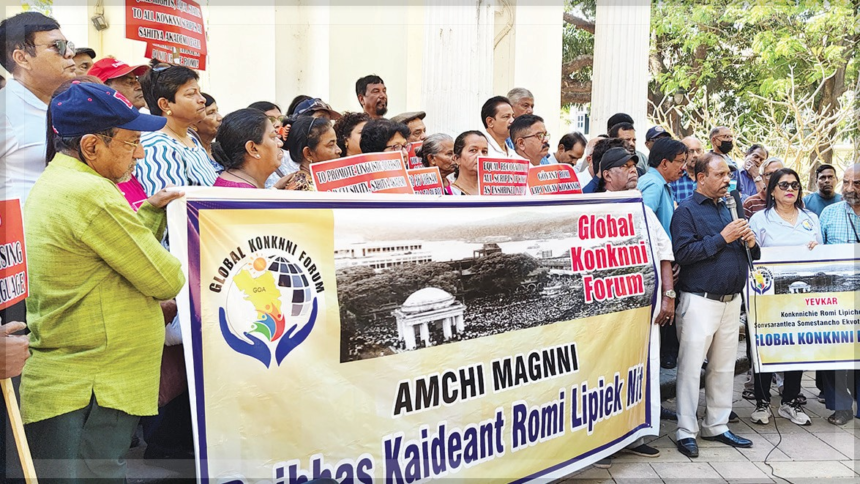
PANJIM: Romi Lipi supporters held a peaceful protest at Azad Maidan, Panjim on Tuesday, demanding equal recognition to all the Konkani scripts as enshrined in Article 14 and 29 (1) of the Constitution.
They warned the State government to take note of their demand to include Romi Konkani as an official language of the state or face protests and court battles in the near future.
They supporters alleged that many persons who took a part in the agitation for justice to Romi Konkani also did not do anything for the injustice meted out to the script. More on Pg 2 >>