SHASHWAT GUPTA RAY

PANJIM: Government-aided private schools are fast becoming the preferred choice for parents in Goa, outpacing both fully government-run institutions and unaided private schools. The trend reflects a growing perception that aided schools strike the best balance between affordability and quality — even as the State pushes to upgrade its own education system.
Aided schools are private educational institutions that receive partial or full financial support — such as grants or salary coverage for teachers — from the government or local authorities. They must follow government regulations and cannot charge excess fees.
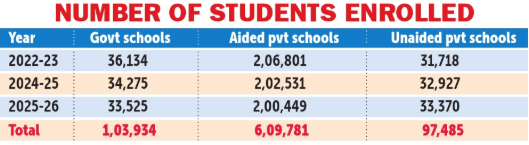
According to data shared by the Directorate of Education, Goa for the academic years 2022–23, 2024–25, and 2025–26, there are a total of 1,03,934 students in government schools, 6,09,781 in aided private schools, and 97,485 in unaided private schools.
Abhijit Patil, a businessman and father of a Grade 4 student, said that government-aided private schools are preferred over both government and unaided private schools because they maintain a balance between cost and quality of education.
“I send my daughter to a government-aided private school. I can see a marked difference between the quality of her education and that of some students studying in government schools. The infrastructure is better, and the teachers are also committed,” Patil told O Heraldo.
He added that while private schools offer many extracurricular activities, accountability is also higher.
“The number of extracurricular activities organised by my daughter’s school is quite high. There is a strong focus on hands-on learning beyond regular academics. It not only makes the learning process more engaging but also supports the child’s overall development. Plus, teachers in private schools are much more involved, as their performance is monitored. I don’t find the same level of accountability in government schools,” Patil said.
Information technology professional and mother Sangeeta Naik, whose son studied in a private school affiliated with the Indian Certificate of Secondary Education (ICSE) board, said that along with teaching quality and infrastructure, ICSE and Central Board of Secondary Education (CBSE) schools have the added advantage of a uniform syllabus.
“If someone wants to move to another State, studying in an ICSE or CBSE school helps, as it is easier for the child to adapt to the syllabus. It also makes it easier to prepare for competitive exams, since the syllabus is largely similar,” she said.
However, she added that Goa Board schools have their own advantage, particularly in higher grades.
“The chances of scoring higher percentages are greater in Goa Board schools, which helps when seeking admission to colleges outside Goa, where cut-off marks are often very high,” she said.
Defending government-run schools, Director of Education, Government of Goa, Shailesh R. Sinai Zingde, said the State is investing significantly in infrastructure and improving teaching quality.
“The government is fully committed to enhancing the quality of education and infrastructure in State-run schools and bringing them on par with private institutions. In fact, in Goa, you won’t find a single government school without benches. We are also providing high-quality training to teachers. Government schools are as good as their private counterparts,” Zingde said.
However, he noted that the growing preference for private schools, especially aided ones, is largely perception-driven.
“Due to rising per capita income, more parents can now afford private schooling. Also, many children — particularly from migrant families — initially enrol in government schools and may be academically weaker. Our teachers work hard to improve their standards. Once they progress, they often move to private schools,” he added.
He also pointed out that some aided schools are allegedly charging excess fees, which is illegal.
“Some schools disguise additional charges as Parent-Teacher Association (PTA) fees, maintenance charges, and other levies,” he said.