KARSTEN MIRANDA
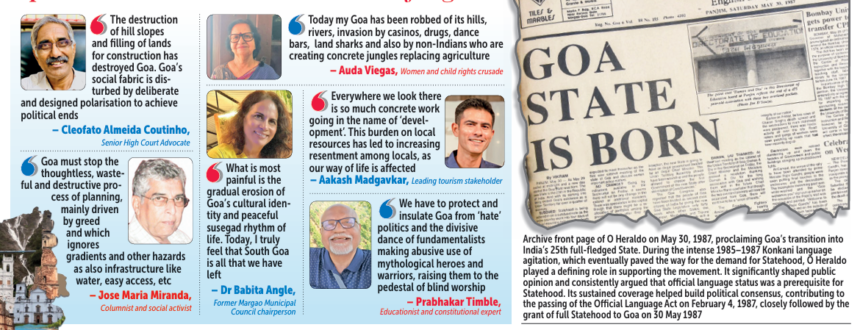
As Goa marks Statehood Day, several prominent voices from across sectors expressed deep con cern over the direction in which the State is headed, questioning whether it has managed to preserve the identi ty, ecology, social harmony and quali ty of life that once defined it. While acknowledging the signifi cance of Goa attaining Statehood in 1987, many reflected on what they described as uncontrolled development, en vironmental de struction, political instability, demo graphic pressures and the gradual ero sion of Goa’s cultural and linguistic character. Senior High Court Adv Cleofa to Almeida Coutinho said the Goa of today was becoming a poor reflec tion of what the State once was. “The main concern is Goa is becom ing a poor image of what Goa was. The exploitation of Goa’s beauty through homestay policies coupled with Goa as a second home destination is making Goa a concrete jungle. The destructionof hill slopes and filling of lands for construction has destroyed Goa. Goa’s social fabric is disturbed by deliberate and designed polarisation to achieve politi- cal ends,” Adv Coutinho said.

“We require an administration that is liberal and respects ecology and environment. As a small State the ad-
ministration ought to have been good as smaller units are better handled. But the jobs scam, Romeo Lane tragedy, Cholera deaths at Cutbona have high- lighted the bad administration we had so far. Nothing works without palms being greased. This has put the govern- ment into a pit,” Adv Coutinho added.
“As a small State the elected have made mince meat of the people’s mandates by large scale shifting of loyalties. People are getting cynical of elections and democracy. The Roman script Konkani deserves considera- tion as the script and language will disappear if not safeguarded,” Adv Coutinho said further.
Leading tourism stakeholder Aakash Madgavkar said unplanned development and pressure on limited resources were steadily changing the character of Goa.
“Goa has always been a place where there has been plenty of greenery but in the last few years, that green- ery has drastically reduced & been replaced with so much unplanned, haphazard development, with so much stress on the limited resourc- es of the State, like water, electricity, garbage management, roads etc,” Madgavkar said.
“Everywhere we look there is so much concrete work going in the name of ‘development. This burden on local resources has led to increasing resent- ment among locals, as our way of life is affected,” Madgavkar added.
“People come to Goa for the greenery, clean air and easier way of life. Unfor tunately, all this rampant development has led to a major compromise of these key aspects, which is the true essence of Goa and what makes Goa ‘GOA’,” Madgavkar said. “The changing concrete scenery of Goa makes it look just like any oth er city which people are trying to escape, or just like any other competing tourist destination which people might find closer or cheaper,” Madgavkar observed. “The urgent need of the hour is to have scientific carrying capacity studies undertaken in each area of Goa. The destructive devel opmental works need to be stopped in congested/sat urated areas and planned in a proper manner in other areas, with no com promise to the natural en vironment, local resources & the Goan way of life. This has to be done to protect Goa for the present and future generations,” Mad gavkar added. Former Margao Munic ipal Council chairperson Dr Babita Angle said re cent visits to North Goa left her deeply disturbed by what she described as uncontrolled growth and increasing pressure on the State’s fragile infrastruc ture. “As a Goan, today I cry for my Goa. I have just re turned from Baga after spending a few days there, and I was deeply saddened by what I witnessed. The entire stretch of North Goa — Baga, Calangute, Candolim and surround ing areas — appears to be collapsing under uncon trolled and irresponsible growth. The endless rise of bars, nightclubs, hotels, shacks, casinos, traffic, and unchecked commercial activity has transformed these once-beautiful plac es into overcrowded and chaotic spaces,” she said. “The pressure on Goa’s fragile infrastructure and natural resources is im mense.
Narrow roads are choked with traffic, noise pollution has become a norm, waste is irrespon sibly strewn around, and locals are constantly dis tressed. Hills are disap pearing, forests are being depleted, orchard lands are converted indiscrimi nately, and the sand dunes that once defined Goa’s coastline have nearly van ished. Equally concerning is the growing sense of insecurity for women and the absence of effective regulation,” Dr Angle add ed. “What is most painful is the gradual erosion of Goa’s cultural identity and peaceful susegad rhythm of life. Today, I truly feel that South Goa is all that we have left. I may sound harsh in saying this, but perhaps we now need a ‘Republic of South Goa’, where one would require a passport to enter — if only to preserve the last remaining soul of Goa,” Dr Angle said further. “Government needs to create opportunities for our youth and a non-cor rupt entrepreneurial at mosphere to attract better commerce,” she added. Women and child rights crusader Auda Viegas said she was pained by what she described as the de struction of Goa’s natural and cultural heritage. “I fought to protect our unique identity with its rich language and cul ture and beautiful natural beauty. Today my Goa has been robbed of its hills, rivers, invasion by casinos, drugs, dance bars, and land sharks also by non-Indians who are creating concrete jungles replacing agricul ture,” Viegas said. “I am totally upset with what is being permitted to happen with no feeling for my Goa. The rent-a-vehicle where renters make mon ey while life is lost. The government we elected has permitted destruction for personal benefits.
It has now hit rock bottom and locals are facing the brunt,” Viegas added. “Time to stop all that is against us and renew our resolve to retransform mother Goa to its original grandeur, beauty and to its original self,” she said. Educationist and consti tutional expert Prabhakar Timble said the concerns facing Goa today were so cial, environmental and cultural in nature. “The concern about our Konkani-speaking land with distinctive person ality is four-fold,” Timble said. “Firstly, Goans are losing their intrinsic lifestyle — harmony, peace, friendly disposition and liberal in thought,” Timble said. “Secondly, Goans are los ing the ownership of their lands due to sale by locals and also due to conver sions of agricultural lands and orchards into settle ment,” he added. “Thirdly, climate chang es in Goa as a concomitant of reckless environmental damage and real estate invasion,” Timble said fur ther. “Finally, Goa is becom ing a dirty jungle of un treated solid waste and unmanaged plastic and medical waste,” Timble observed. “We have to protect and insulate Goa from ‘hate’ politics and the divisive dance of fundamentalists making abusive use of mythological heroes and warriors, raising them to the pedestal of blind wor ship,” Timble added. “The State should enact new laws to answer the threats posed due to land conversions and aliena tion. The highest priority in public projects and public spending should be provid ed to public health, waste management and pub lic transport.
We should search for growth options in education, informa tion technology, horticul ture and tourism,” Timble said. “As a community, we are losing the core values which made Goa a bou quet of humanism. The arrogance of religion and the pride of blind faith are capturing our lives. We may be bequeathing an economically improved land but the sadness is that the social and communi ty health clock is moving backwards,” Timble added. Columnist and social ac tivist Jose Maria Miranda said Goa’s distinct identi ty and cultural character should have been pre served more carefully after Statehood. “On the anniversary of Goa attaining greater au tonomy and having, hope fully, buried, once for all, the hatchet of a disdainful merger, my first sincere thoughts are that Goa ought to have maintained its smallness, uniqueness, identity and character and that India ought to have showcased Goa as a piece of the West in the East, dis tinct from the rest of the country,” Miranda said. “Perhaps both Goa and India would have benefit ted much more from the charm, which the State still maintains, thanks main ly to the hospitality and docility of our people,” he added. “What attracts people, both Indians and foreigners, to Goa are, of course, our fields, beaches, hills, riv ers and lakes, but also and surely, the deep touch of the West, which we still main tain, much to the dismay of some wishing to erase ves tiges of the past,” Miranda said. “Goa must stop the thoughtless, wasteful and destructive process of planning, mainly driven by greed and which ignores gradients and other haz ards as also infrastructure like water, easy access, etc,” Miranda observed. “It must concentrate on sustainable development, take into account Goa’s carrying capacity, whether Goa needs any more hous ing and avoid altogether mega projects seriously affecting the demography of the place, construction in fields, water bodies, and destruction of hills, sand dunes, etc,” Miranda added.
As Goa marks anoth er Statehood Day, the voices reflected both pride in the State’s dis tinct identity and grow ing anxiety over wheth er that identity can still be protected in the years ahead.