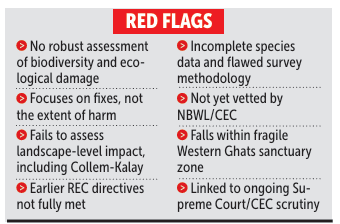
The Centre has deferred Goa’s renewed bid for forest clearance regarding the contest ed Collem-Margao dou ble-tracking stretch. The Regional Empowered Com mittee (REC) highlighted critical gaps in the Wild life Institute of India (WII) study, insisting on a more rigorous assessment of the project’s ecological impact before the proposal can be reconsidered. The REC, which examined the state’s fresh request to lift the stay on forest land diversion, observed that the WII report is largely confined to recommend ing mitigation measures.
The committee noted that the report fails to provide a sufficiently detailed anal ysis of the project’s impact on biodiversity and ecology within the Bhagwan Maha vir Wildlife Sanctuary. In its findings, the com mittee stressed that mit igation measures alone cannot justify clearance. It called for a comprehen sive evaluation of the eco logical consequences of double-tracking within the protected forest landscape. Furthermore, the panel directed that the propos al must first be presented to the standing committee of the National Board for Wildlife (NBWL) or the Central Empowered Com mittee (CEC) for a decision before returning to the REC — effectively adding anoth er layer of scrutiny to the delayed project. This latest deferment follows previous REC direc tions. In earlier meetings, the committee declined the proposal and instructed the project proponent to expand the study’s scope to include the Collem-Kal ay section, a critical stretch within the sanctuary. This decision was formally com municated to the state gov ernment in March 2025, with the committee reit erating that a cumulative impact assessment of the sanctuary landscape is a prerequisite for any fresh appraisal. While the WII was sub sequently tasked with this study, the REC has indicat ed that the current report does not adequately ad dress biodiversity impli cations. Consequently, the proposal remains short of the previously established requirements.

The Mollem stretch re mains the most contentious segment of the broader double-tracking project, even as work progresses in non-forest areas. The current impasse dates back to May 12, 2022, when the REC ordered that the approval for diverting 15.6 hec tares of forest land for the Collem-Margao section be kept in abeyance following Supreme Court proceedings. The court had been petitioned by the Goa Foundation, leading the Central Empowered Committee to recom mend revoking the project’s wildlife clearance, citing con cerns over forest diversion through ecologically sensitive areas of the Western Ghats. The stretch under scrutiny is part of a larger alignment from Tinaighat-Castlerock in Karnataka to Collem in Goa, involving the diversion of approximately 120.8 hectares within Goa’s Bhagwan Ma havir Wildlife Sanctuary and an additional 10.45 hectares in Karnataka. Although the NBWL standing committee had recom mended the double-tracking proposals for both states in 2019 and 2021, those approvals were challenged, trigger ing the current cycle of re-evaluation. In March of last year, the state government and Rail Vikas Nigam Limited (RVNL) sought to revoke the abeyance order; however, the REC re jected the request, maintaining that environmental assess ments remained unsatisfactory. Goa’s latest push for clearance indicates that key envi ronmental concerns — particularly regarding biodiver sity — remain unresolved. The deferment also coincides with growing scrutiny of the WII’s Environmental Impact Assessment (EIA).
The Save Mollem campaign recently flagged what it described as “serious gaps, omissions, and inconsistencies in the study,” specifically highlighting con cerns over “species data, survey methodology, and missing ecological groups.” As a result, while double-tracking continues in less sen sitive areas, the Mollem segment remains stalled pending a more scientifically robust assessment to determine if the project can be justified within such a sensitive landscape.