QUEPEM: The Quepem Zonal Agriculture Office has reported that paddy farmers have begun cultivating black rice in certain parts of Quepem taluka, notably in Cacora, Curchorem, Balli and Pirla, on the Sanguem border. Three farmers in these villages have successfully cultivated the exotic variant of rice, said the official.
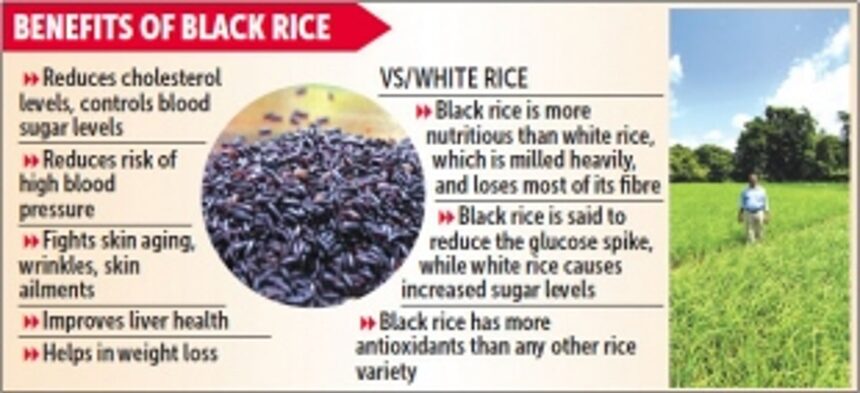
Black rice, also called ‘purple rice’ or ‘forbidden rice’, constitutes a variety of rice strains within the species Oryza sativa, some of which are glutinous rice. Originally grown in the North-Eastern States and certain regions of Tamil Nadu, black rice is renowned for its extensive health benefits and medicinal properties. The rice boasts a deep black hue that transforms into a rich purple upon cooking. Its captivating colour is attributed to its high anthocyanin content, surpassing that found in other grains. Black rice is employed in diverse culinary preparations including porridge, desserts, traditional Chinese black rice cake, and even gluten-free bread and noodles.
Given its numerous health benefits and high levels of amino acids, flavonoids, anthocyanins and vitamins, the rice commands a premium in the market, fetching Rs 400 to 500 per kilogram. The nutritive worth and escalating demand for black rice prompted the Zonal Agriculture Office in Quepem and the Agriculture Technology Management Agency (ATMA) South to introduce black rice cultivation through instructional demonstrations for select farmers.
Black rice requires a slightly longer cultivation period (120-130 days after transplantation), said ZAO Sandesh Desai.
“The collaborative efforts of ZAO Quepem and ATMA South are aimed at fostering black rice cultivation to bolster the well-being of farmers like Dayanand Fal Dessai from Pirla, Sunil Sawant Dessai from Cacora, and Kapil Velip from Balli, who have already embraced black rice cultivation.
Their positive experiences and encouragement are inspiring fellow farmers to follow suit,” said Desai.