SHASHWAT GUPTA RAY
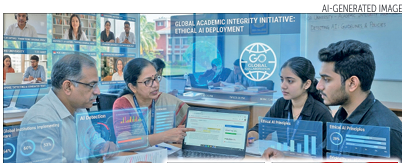
With the grow ing use of AI-based tools by students for research and project submissions, the number of students falling prey to AI plagia rism is also increasing. Keeping this in mind, educational institutions in Goa are tackling the issue by using paid soft ware such as DrillBit and Turnitin to enforce strict academic integrity and uphold originality. Principal of the Government of Goa’s College of Multi disciplinary Studies & Research (Auton omous), Margao, Dr F M Nadaf said the college uses DrillBit plagiarism software to ensure academic integrity. Unlike free tools, this paid software effectively de tects both traditional plagiarism and AI-generated content. As per UGC guidelines, a similarity index of up to 10% is permitted.

Accordingly, all students are required to check their work using the soft ware and submit a certificate confirming that their similarity index does not exceed the pre scribed 10% limit. “Plagiarism detection results can often be sub jective, as detection capabilities vary across dif ferent software platforms. This variation largely depends on the size and scope of the software’s database; a more extensive database generally leads to higher detection rates,” Prof Nadaf said. In many cases, Turnitin is considered the most effective tool available, though it requires a paid subscription. “At present, our formal regulations specifically address plagiarism, with established discipli nary action based on the percentage of unorig inal work. For instance, penalties are applied at various thresholds, such as up to 10%, between 10% and 40%, and above 40%.
However, we cur rently have no formal provisions or rules regard ing AI use,” Dr Nadaf said. “Consequently, even if a submission consists primarily of AI-generated content rather than original work, institutions currently lack the ad ministrative grounds to take direct action. But we advise students to use these tools and the content they generate judiciously, as international jour nals typically do not accept papers with a similari ty index or AI-generated content exceeding 20%,” he said. Speaking on condition of anonymity, a Goa University faculty member said tools such as Turnitin and DrillBit are increasingly being used to detect AI-generated research work. “While there is a noticeable increase in AI us age as more people become familiar with the technology, the extent of its use often depends on an individual’s commitment to original crea tivity versus automated assistance,” he said. In many instances, students use AI tools pri marily to identify errors or fine-tune the lan guage in their assignments. “This practice should be considered accept able, as it serves as a useful proofreading aid for those seeking to improve the quality of their writing.
Furthermore, the process can be an effective learning tool, helping students under stand how to structure their work more profes sionally,” he said. The senior lecturer added that AI use in stu dent submissions can generally be categorised into two approaches: complete reliance on AI for content generation or using AI as a tool for grammatical refinement and learning. “While automated detection systems are available, educators often identify discrepancies based on their familiarity with a student’s typi cal performance and writing style. I propose that assignments be linked with a viva or presenta tion. Requiring students to defend their work through a questionnaire or verbal examination would more accurately verify whether the sub mission reflects their own effort or is merely the result of AI tools,” he said.
Prof Rahul Tripathi of the Political Science Discipline at the D D Kosambi School of Social Sciences, Goa University, encourages his stu dents to use AI as a collaborative tool rather than a primary source. “To demonstrate this, I con duct a classroom exercise where students define a phenomenon in their own words before com paring it with an AI-generated definition. This exercise often reveals that students’ perspec tives are comparable to AI outputs, effectively dispelling the notion that AI-generated content is inherently superior,” Prof Tripathi said. Once the initial misconceptions are addressed, students generally prefer to use AI as an intelli gent assistive tool.
They understand that their work must remain within stipulated AI detec tion limits to avoid the potential rejection of their assignments. “On a broader scale, I feel that rather than maintaining a hostile stance towards AI, the ob jective should be to use it as an assistive tool that enhances and maximises students’ critical think ing abilities,” he said. Assistant Professor of Civil Engineering at Don Bosco College of Engineering, Fatorda, Satyesh Kakodkar said that as colleg es increasingly use licensed software to detect AI-generated or plagiarised content, students are frequently asked to rewrite flagged material. “There is a growing concern that creative ef fort has diminished, as many students rely on tools like ChatGPT to generate content rather than producing original work. While AI tools such as Grammarly can be helpful for refining language and making corrections, many stu dents directly copy content without attempting to paraphrase or rewrite it. We try to discourage this practice,” Kakodkar said.