Dolcy D’Cruz
International Tea Day is observed annually on May 21, according to the United Nations. The International Tea Day aims to raise awareness of the long history and the deep cultural and economic significance of tea around the world. International Tea Day has been celebrated in tea producing countries like India, Sri Lanka, Nepal, Vietnam, Indonesia, Bangladesh, Kenya, Malawi, Malaysia, Uganda and Tanzania. In Goa, tea is enjoyed throughout the day. Just after waking up, another cup while having breakfast, a mid-day cup of the strong brew and then after a hearty lunch and later in the evening, there is no shortage of tea. With the markets offering a variety of tea, one of the favourite of many Goans is the rose tea. Not just in Goa but many Goans living abroad too, don’t forget to shop for their favourite tea when they are down for holidays. Fatima da Silva Gracias is a historian with a doctorate in the domain of Indo-Portuguese history. She is the author of the ‘Cozinha de Goa books— History and Tradition of Goan Food’. For her, tea is a seasonal preference. During the rainy season, she generally prefers tea, while at other times coffee is her favourites. “I presented my paper, Tea Time Delight, at an international seminar in Delhi in 2013. The paper explored the different foods traditionally served with tea among Portuguese, Hindu, and Christian communities in Goa.

Tea-time snacks in Goa include a wide variety of dishes, many of them made with jaggery and coconut. I divided the paper into three sections. The first focused on Hindu tea-time snacks such as bhajis and other savouries. The second dealt with traditional sweets made with coconut and jaggery. The third section explored the Portuguese influence, including cakes and other baked tea-time delicacies In India, tea has always played an important role in hospitality. Whenever someone visits the house, the first thing we ask is, “Would you like a cup of tea?” In the past especially, tea was served at any time of the day. Tea was not easily available in Goa earlier. It became more accessible after the Anglo-Portuguese treaty between the British and the Portuguese. Initially, tea was consumed plain, without milk. Interestingly, today many people are returning to that style with green tea and other varieties of plain tea,” informs Fatima. Fr Myron Barreto, president of Dalgado Konkani Akademi, shares Konkani sayings that show the love for tea. “Cheav mhaka pie naka mhonn sangchem, punn cheav mhaka diunk visorchem nhoi which means Tell me not to drink Tea, but don’t forget to offer me tea. Another saying is ‘Cheav ani gozali — sogllea dukhancho upai’ which translates to Tea and conversation are the remedy for every worry. There is also ‘Goyant, zaitio mogachio gozali, cheav piyetanam suru zatat which translates to In Goa, many loving conversations begin over tea.
A person who loves tea is called jea konnak cheav avoddtta in Konkani while a lesser used term is Chayechem bhann,” says Fr Myron. Odette Mascarenhas is an Indian food historian and her 2015 book, ‘The Culinary Heritage of Goa’, was awarded as the Best in the World for Historical Recipes at the Gourmand World Cookbook. “I am a coffee person in the morning because it helps keep me awake. In the evening, I prefer herbal tea for relaxation. There probably was a strong Portuguese influence on tea drinking in Goa. In the 16th century, when the island of Bombay was handed over by Portugal to Britain, a Portuguese princess married into the British royal family and later became queen. She made tea drinking extremely popular in England, and that was really the beginning of the famous English tea parties. It is important to remember that she was Portuguese and came from nobility. If you notice, our grandparents and people in earlier generations also had the tradition of evening tea, especially the strong “karak chai” around four o’clock, often accompanied by snacks like bangle breads. Even though tea had to be imported, the Portuguese brought many new customs and food habits into Goa. Therefore, the practice of drinking tea may have become more widespread than coffee, even though tea plantations were far away. Coffee, in contrast, was considered stronger, darker, and perhaps more expensive in Goa at that time,” says Odette. She further adds, “Among ordinary rural households, tea became a daily beverage. It was certainly brought through trade, but people could afford the cheaper varieties.
Joyce Aguiar
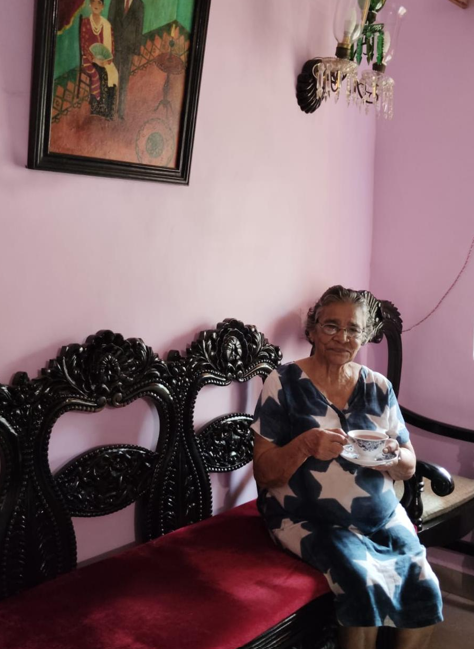
Tea would be boiled for a long time on the stove until it became strong and flavourful. At that time, it was mainly black tea made from tea leaves rich in tannins. The Portuguese queen played a major role in making tea drinking popular throughout Britain. Britain did not originally have a tea-drinking culture, so it is fascinating to see how a Portuguese woman helped shape what later became one of Britain’s most famous traditions. “A cup of tea is not just a drink for me, it is a little pause where the heart feels warm and the mind feels calm. Every sip carries comfort, memories, and a bit of happiness. It boosts me, I must admit,” says Joyce Aguiar from Colvá, a grandmother, as she sipped hot tea from her cup. Tea in Goa is far more than a daily drink, it is a symbol of warmth, hospitality, memory, and community. Whether enjoyed as a strong evening chai, a soothing herbal infusion, or a simple cup offered to a guest, tea continues to bring people together, one comforting sip at a time.