SHASHWAT GUPTA RAY
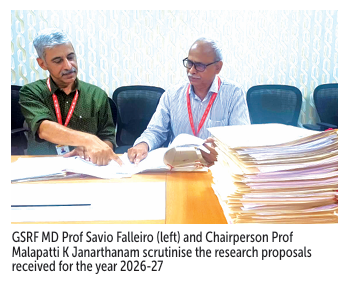
Samantha Da Cos ta, a PhD scholar at Goa Uni versity’s School of Chemical Sciences, recently complet ed her research focusing on developing catalytic meth ods for diesel exhaust emis sion mitigation to control air pollution. This was made possible by the Rs 6.5 lakh fellowship received from the Goa State Research Foundation (GSRF) for her PhD research (2024–26). “The funding was in strumental in procuring high-quality, sterile con sumables and specialised stationery, required for publication-standard lab work. Additionally, the grant covered conference fees, poster printing, and travel logistics for my pres entation at IIT Guwahati, which would otherwise have been a personal finan cial burden,” Da Costa told O HeraldO. Similarly, Dr Sumod Khedekar, Associate Profes sor and HoD at Gomantak Ayurveda Mahavidyalaya & Research Centre, received Rs 8.2 lakh under the GSRF’s Interdisciplinary Research Interventions Scheme for Local Development (IRIS LD) scheme for a one-year study on iron deficiency and anaemia management in adolescent girls across North and South Goa. “The funding allowed me to conduct screening of students from 20 schools in both districts. It also sup ported the extensive blood investigations and statis tical validation necessary to prove the efficacy and safety of my findings,” Dr Khedekar said. Samantha Da Costa and Dr Sumod Khadekar are among 242 beneficiaries supported through grants and fellowships amounting to Rs 13.13 crore given by the GSRF since 2023-24 to 2025-26. Established in October 2022, the GSRF is actively fostering a research tem perament by providing grants, fellowships, and grassroots training pro grammes. “The GSRF became fully operational in late 2023. The GSRF currently op erates eight schemes to support research and de velopment in Goa: Doc toral Research Fellowship Scheme for full-time PhD students, Post-Doctoral Fel lowship Scheme to support early-career researchers at recognised institutions, and the Major Research Grant Scheme for multi-year funding for regular faculty,” Chairperson GSRF, Prof Mal apatti K Janarthanam said. Then there is the Mi nor Grant Research Scheme,which funds small er, focused projects by full-time faculty, and the Research Start-Up Grant Scheme, which provides seed funding for newly joined faculty. “We also have the Inter disciplinary Research Inter ventions Scheme for Local Development (IRIS-LD) to fund group research aimed at solving local issues and developing policy. Tradi tional Occupations and Skills Documentation and Research for Improving Local Livelihoods (TOS DRILL) aims at researching and documenting tradition al livelihoods,” Prof Janart hanam said. Then there is the Sum mer/Winter School Scheme, which exposes school stu dents, school teachers and UG students to various as pects of research. “The concentration of re search applications main ly pertains to the Science stream, but efforts are on to encourage participation from the Social Scienc es streams too,” the GSRF chairperson said. According to the Manag ing Director of GSRF, Prof Savio Falleiro, the estab lishment of the GSRF has provided a vital platform for both established faculty and young researchers to pursue their work—an opportunity that likely would not exist without this government initiative. “By documenting Goan culture and incentivising interdisciplinary teams to find solutions for state-spe cific challenges, the GSRF is ensuring that academic re search translates into prac tical benefits for Goa,” Prof Falleiro said. While teachers naturally engage in research as a com plement to their teaching, individual institutions often lack the necessary funding to support large-scale pro jects. “The GSRF fills this critical gap, not only by providing financial resources but also by offering essential facili tation through workshops, orientation programs, and expert guidance,” he added.