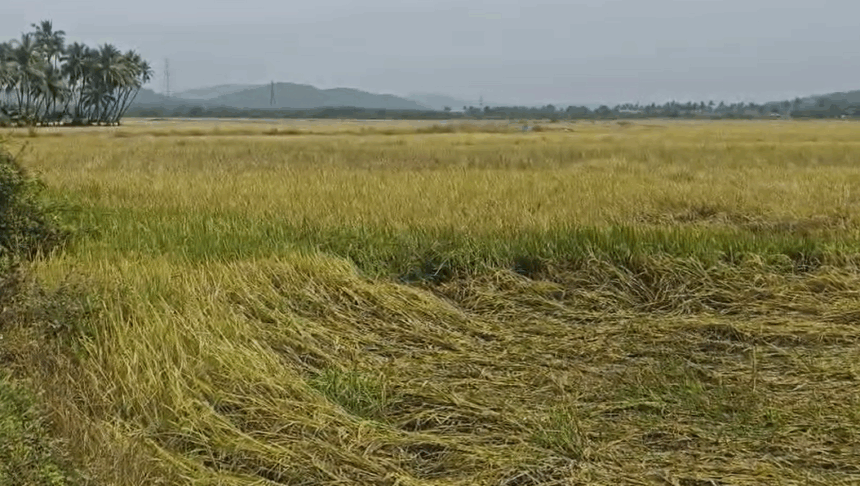
Days of relent less rainfall have created a situation of distress for farmers across Salcete ta luka as their recently har vested paddy crops have been left damaged and un salvageable. With no sunlight to dry the grain, the hard work and investment of an entire season are going to waste, leaving farmers anxious about their future. Reports from several villages, including Nu vem, Raia, Benaulim, and Curtorim, indicate that farmers who had recent ly completed harvesting are now struggling to save their soaked paddy. The unexpected return of heavy rains during what was supposed to be a dry spell has made it im possible to sun-dry the grain—a crucial step to prevent fungal growth and spoilage. “We were waiting for the right weather to har vest and dry the paddy, but the sudden rains have destroyed everything,” lamented Fiona Fernandes, a farmer from Raia, add ing: “The grain has become black and unusable. It is heartbreaking to see our months of effort and ex pense wasted.” In many areas, farmers had stored their harvested paddy in temporary sheds or tarpaulin-covered spac es, hoping for clear skies. However, persistent rain has rendered much of it unusable.
“This year’s yield was already poor due to erratic monsoon patterns,” said Maria D’Souza, a farmer from Benaulim. “Now, the rains have ruined even what little we had. We were depending on this harvest for our family’s income.” Local farmer associations have urged the government to step in immediately and provide relief. “We appeal to the Agriculture Department to conduct spot inspections and compensate affected farmers,” said Sebastian Almeida, representing a Salcete farmers’ collective. Sebastian said, “Without financial support, many small farmers will find it impossi ble to continue cultivation next season.” Agriculture officials have acknowledged receiving reports of widespread damage but said a detailed assessment will be undertaken once the rain subsides. Field assessments in Salcete recorded localised but notable losses. Salcete Zonal Ag ricultural Officer (AAP) Adolfo Da Costa said that about 20% of the crop (in Salcete) — covering nearly 20 hectares — was damaged in the heavy post-monsoon downpour. The affected areas include Curtorim, Nagoa, and Fatorda, where waterlogging disrupt ed harvest schedules even after the weather cleared. Meanwhile, the India Meteorological Department has forecast intermittent rainfall for the coastal belt over the coming days, dampening hopes of drying the grain anytime soon. As the gloomy weather persists, the mood among Salcete’s farming community re mains equally bleak. The continuing rains not only threaten this year’s harvest but also pose a serious challenge to the future of traditional paddy cultivation—once the pride and backbone of Goa’s rural economy