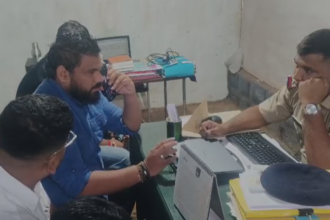
A recommendation by the Superintendent of Police (North Goa) to make CCTV installation — both indoor and outdoor, with proper data backup — a mandatory condition for licensing of establishments, formed the core of the final submission by Amicus Curiae Nigel da Costa Frias before Justices Bharati Dangre and Nivedita P Mehta. The submission came as the Bombay High Court at Goa prepared to dispose of Contempt Petition 12 of 2023.
“The measures suggested by the Superintendent of Police (North) as recorded in this Hon Court’s order dated March 18, 2025 be accepted and implemented forthwith,” stated da Costa Frias in his submission to the court.

The case stems from persistent complaints of noise pollution by certain nightclubs and alleged police inaction in North Goa’s coastal belt, especially Anjuna. “It has been a long battle but worth it, because when things had gone completely out of hand, the High Court stepped in to make it possible for us to be able to get some sleep,”said a visibly exhausted Sibil Fernandes from Anjuna.
A key point made by the Amicus Curiae was that most establishments claimed they could not provide CCTV footage from December 2024, citing lack of backup. Da Costa Frias therefore reiterated: “All establishments should ensure that the CCTV footage being recorded is kept both on a hard disk and backed up online on a cloud-based platform.”
His seven-point submission also referenced previous directives from both the High Court and the Supreme Court of India, including the mandatory operation of a dedicated 24×7 helpline (112) for complaints related to noise pollution.
An affidavit filed by Anjuna Police during the hearing revealed that 338 complaints were made via the 112 helpline from December 1 to 31, 2024. Of these, 269 complaints were deemed false as no music was reportedly found to be playing at those locations.
A separate affidavit noted that between December 21, 2024 and January 1, 2025, the local police station received 96 calls about loud music. In 64 instances, police claimed there was no music being played.
These figures were met with scepticism from locals. “The problem lies in the reaction of the police to complaints being made. If they claim that three-fourths of the complaints are false, where do we stand?”Wondered Roy Cedric of Anjuna. “Had the police been honest in their work, we would never have approached the High Court. It is because they are not complying with the orders of the Supreme Court and directions of the High Court that we are in this mess,” he added.
Another key recommendation by the Amicus Curiae was the continuation of night patrolling by the Local Intelligence Bureau, Beat Staff, and Sub-Division Night Duty Officers — particularly in coastal areas prone to violations of noise laws.
“The sick, the old, and underprivileged children in the village could have a better life had the police been awake when loud music is being played all over the two villages,” said Anna Fernandes, a long-time anti-noise activist from the area.
Fernandes pointed to a key moment when Captain Gerry Fernandes, a member of the High Court-appointed Noise Monitoring Committee (NMC), personally confirmed hearing loud music past midnight, contradicting the police’s claim of no violations.
Da Costa Frias also urged that the Noise Monitoring Committees conduct surprise inspections at shacks, restaurants, hotels, and other establishments in coastal villages. If sound levels exceed permissible decibel limits or music is played beyond 10 pm, he insisted that an FIR be filed at the local police station.
Police records submitted to the High Court showed that 15 cases of loud music were registered between August 4, 2024 and January 1, 2025. Of these, five were filed in August 2024, one in November 2024, four in December 2024, and five in January 2025. The most recent case was registered on July 12, 2025 against the manager of an establishment named Diaz.
To ensure compliance, da Costa Frias proposed strict legal accountability: “Any dereliction of duty or a remiss by any authority should be considered as Contempt of Court and appropriate action under the Contempt of Courts Act, 1971 should be initiated against the errant officers.”