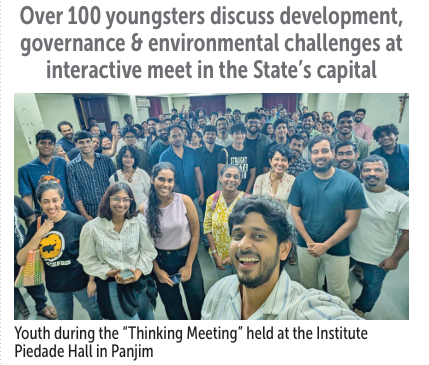
In a sign of youth engagement following the recent ‘Enough Is Enough’ mobilisation, a “Thinking Meeting” held at the Insti tute Piedade Hall in Panjim brought together over 115 young participants to dis cuss Goa’s development, governance and environ mental challenges. The interactive meeting organised under the banner ‘Goa Worth A Fight’, was fa cilitated by activists Sohail Furtado and Tahir Noronha. Organisers said the turnout was more than double what had been expected, with the gathering dominated by participants from the col lege-age group. Noronha said the meeting was framed as a response to what he described as a per sistent narrative that young Goans were absent, apa thetic or ‘susegad’. Accord ing to him, young people are engaged, anxious and ready to act, but continue to struggle to find space with in Goa’s civil society. Noronha said that ‘youth’ in India is often treated as an amorphous category, commonly understood to span ages from 18 to 39. He said that across politics and public movements, many leaders described as ‘youth’ are already in their 40s, leaving those in the 18–35 age group underrepresent ed at protests and in main stream media. While Noronha and Fur tado are among the more visible younger faces in land and environmental movements in Goa, the Pan jim meeting itself reflected a different demographic. More than 115 young people attended the interactive session — more than double what the organisers had expected — with a strong presence of college-age participants. Furtado said the idea for the meeting emerged as protests escalated across Goa, with younger participants repeatedly being provoked by old er generations about youth absence. “So we set out to ask them why — what’s holding you back, and what are the issues you want us to take up?” he said. Participants raised a range of concerns during the discussion, including garbage management, water supply, safety — especially for women — unregulated construction and infrastructure in government institutions. Noronha said that while the issues varied, a central question kept resur facing. “The major issue was how to start trying to get change from the government: What are the approaches to take? Whom do we approach?” he said. Safety concerns featured prominently, particularly in the wake of the recent assault on activist Rama Kankonkar. Furtado said fear and insecurity were among the key reasons discour aging youth participation. “We need solidarity. When people are together at protests and meetings we keep ourselves motivated, and safe. There is security in numbers,” he said. Noronha said the discussion also brought out what participants de scribed as a dismissive attitude from older generations, which he said discourages youth participation. During the meeting, he said there were instances where older individuals attempted to dominate the discussion. At one point, when an older activist said he had come to advise the youth, Noronha intervened. “We are here to listen to young people, not tell them what to do,” he said. The youth meeting took place against the backdrop of the recent ‘Enough Is Enough’ public mobilisation led by Justice (retd) FerdinoRe bello, which culminated in a 10-point charter of demands on governance, development and environmental protection that was later submitted to the Chief Minister. Noronha had been among the speakers at that earlier public meeting, providing continuity between the wider civic mobilisa tion and the youth-focused discussion in Panjim. Looking ahead, Furtado said the organisers discussed continuing such interactions on a regular basis. “We felt community today and we’re going to continue this, at least monthly, in different parts of the State,” he said. He also spoke about listening sessions in rural areas, an interactive ses sion with Justice Rebello to gather youth feedback on the charter, and sup port meetings where young people working on various issues can share experiences and seek volunteers. “On some issues like rural garbage collection, we have people in our circle who have been successful. We can now start explaining how we’ve done it, or link up resource people to those who want to act,” Noronha said. Summing up the mood at the meeting, one participant said, “The youth are awake, they are asking intelligent questions and have ideas. We just need to come together so those in power, and in opposition, listen.”
It’s now the turn of youth to say, ‘Enough is Enough’