CANACONA: The mystery over so many unexplained renal (kidney) failures in Canacona has given sleepless nights to the residents of Canacona, with questions being raised “When more than 50% of Goa’s renal failures are from Canacona, how long the health department will slumber on the issue?” There is no proper record on how many kidney patients and their immediate families are suffering from this mysterious dreaded disease.
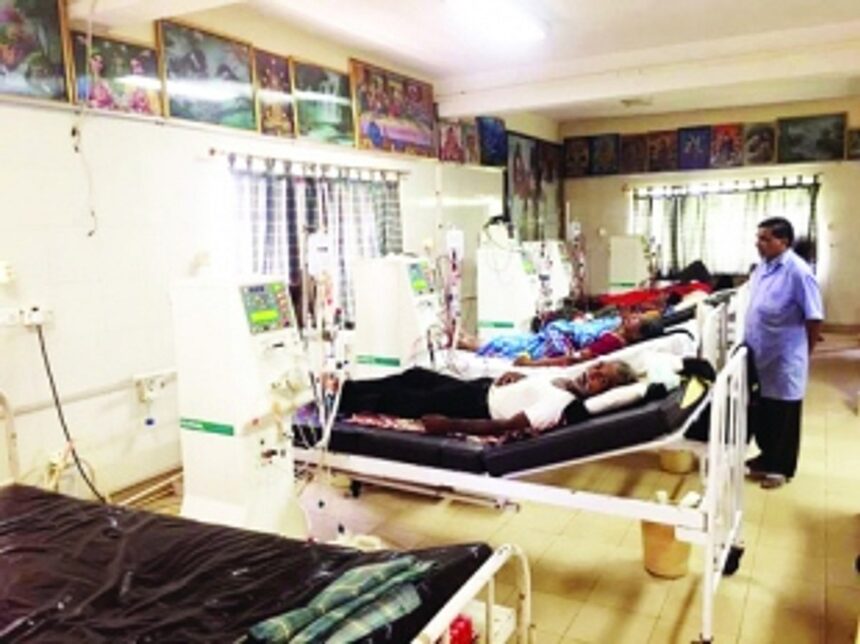
As Canacona Taluka is economically backward, most of the affected line up at the Government Primary Health Centre (PHC) at Chaudi which has nine dialysis units.
The Chaudi PHC is the only centre out of 5400 health centres all over India which has a dialysis centre in itself explains that Canacona is the capital of kidney disorders in the country.
Some patients who cannot be treated at the PHC visit District Hospital at Margao, or the GMC at Bambolim, and affluent ones visit high-end private hospitals for dialysis which is normally thrice a week.
A study done by KLE Kidney foundation, Belgaum and published in Indian Journal of Science and Technology Vol 3 of March 2010 states that, in the free medical camp organised by the Dept of Urology, by KLE’s Kidney Foundation they examined close to 300 patients and inferred that out of them 41% had urolithiasis, 13% had LUTS secondary to Benign Prostatic Hyperplasia and 13% chronic renal failures, it was concluded that there is unusually high prevalence of kidney disorders among the inhabitants of Canacona taluka.
This high incidents of kidney disorders in Canacona has been a great concern for the locals for several decades, which has led to mass migration to nearby towns, it is also a worry for parents with eligible children as out of Taluka parents refuse the proposals in Canacona on the ground that they might be victims of this dreadful disease at a later stage in life.
The locals have time and again raised this issue with their local elected representatives as well as health administrators. The issue was even raised on several occasions in Rajya Sabha and Lok Sabha in the past.
A team from ICMR (Indian Council for Medical Research) which conducted a study on environmental cum Biological monitony in 2005, concluded saying, “Clinically the disease seemed to be familiar to Balkan Endemic Nephropathy (BEN) which is an environmentally acquired disease possibly caused by mycotoxin produced by fungi in mouldy cereals and food products and aromatic compounds in drinking water.”
Some studies point out to the fact that there is presence of radioactive elements like Thorium and Radon above permissible limits in the rocks of Canacona, making the ground water alkaline but a PH test of municipal water treated and supplied by PWD, Canacona suggested that it is neither acidic nor alkaline. Some experts in medical field in the past and present squarely blame the govt for neither accepting the earlier studies nor conducting any study over this matter.
Some time there is also unconfirmed complains that water in Canacona is having excess minerals like Potassium, Calcium, Magnesium, Sodium and Phosphorous which has potential to affect Kidney functions.
A detailed study conducted by Herald by speaking to a cross section of the affected people and experts in the field of medical science point out to the following never touched areas which could point a finger towards the mystery over excessive Kidney disorders in a taluka with about 70,000 population.