Team Herald
MARGAO: Farmers in Loutolim are taking steps to get their unique Korgut rice variety Geographical Indication (GI) tagged, while simultaneously battling the high-level Borim bridge project that threatens their khazan lands. The farmers have formed a dedicated committee to pursue the GI registration, with J Santano Rodrigues initiating the process under the guidance of Deepak Parab from the State’s Science and Technology board.

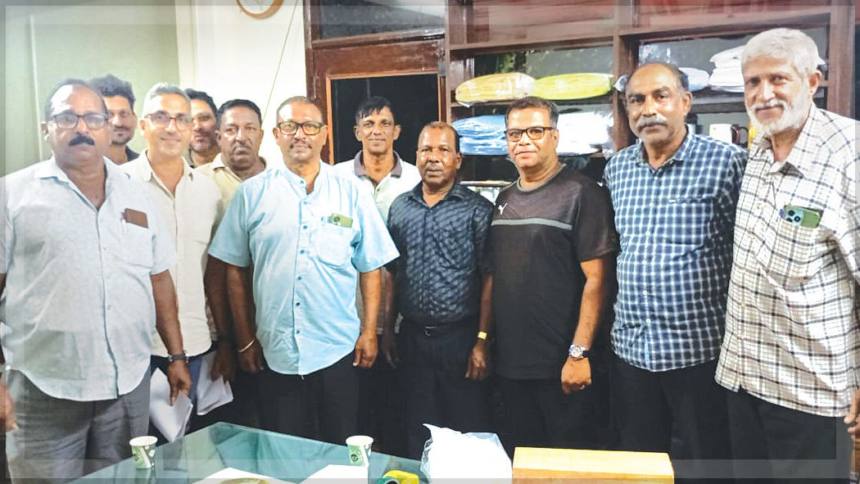
The committee comprises local farmers including Albert Pinheiro, Hipolito D’Costa, Jose B A Gracias, Paul De Sa, Valeriano Fernandes, Gabriel Fernandes, Leo Andrade, and Matthew Oliveira.
This initiative is part of the Goa PRIs Union Agro-Biodiversity Team’s efforts, with Santano Rodrigues serving as a Goa Agro-Biodiversity Team member, Convenor of Goa PRIs Union, and Chairman of the Curtorim Biodiversity Management Committee (BMC) and Cuddtari Agro-Biodiversity Farmers Club.
Speaking to OHeraldo, Albert Pinheiro, president of the Carbot, Mascasana & Bebdo Tenants Association in Loutolim, shed light on the unique characteristics of their Korgut rice.
“This rice is special,” Pinheiro explained. “It’s completely organic, with no fertilisers or pesticides. What makes it truly remarkable is its ability to survive in saline water. Even if it gets submerged, it still grows and gives a good yield.”
Highlighting the rice’s distinctive properties, Pinheiro noted, “It’s particularly good for diabetic people and is now in demand, selling for 85 to 90 rupees a kg. The brownish cover has medicinal value, so even boiling requires special care to prevent breaking in the mill.” He emphasised a unique culinary aspect, stating, “It’s especially good for kanjee (pez) because unlike other rice varieties, the boiling water can actually be consumed.”
The key unique factors of the Korgut rice go beyond its market value. Its ability to tolerate waterlogging is particularly crucial during monsoon seasons, a characteristic that sets it apart from other agricultural varieties in the region.
The Korgut rice variety shows remarkable adaptation to specific local conditions. While similar salinity-resistant crops exist in other areas, the Loutolim variety stands out for its unique combination of characteristics. Similar crops are cultivated in other coastal areas of Goa, including Rachol-Camorlim, Neura, Chorao, Divar, that share similar climate and soil
conditions.
Traditional cultivation methods play a crucial role in maintaining the rice’s unique properties. Unlike modern agricultural practices that rely heavily on chemical interventions, the farmers of Loutolim have preserved a traditional approach that allows the Korgut rice to thrive naturally in challenging coastal environments.
The pursuit of the GI tag represents a critical effort to formally recognize and protect this unique agricultural heritage. It goes beyond mere economic considerations, touching on broader issues of biodiversity conservation, traditional farming practices, and cultural preservation.
Local experts point out that the proposed bridge project poses a significant threat to these carefully cultivated khazan lands. These lands, maintained for generations, represent more than just agricultural space – they are a living ecosystem that supports a unique method of farming deeply rooted in local traditions.
It may be recalled that the farmers from Loutolim along with their counterparts from Borim, have been challenging the bridge project for the past year-and-a-half, with their next NGT hearing scheduled for February 21st. They are also preparing to approach the high court to protect their fields, demonstrating their commitment to preserving their agricultural lands.