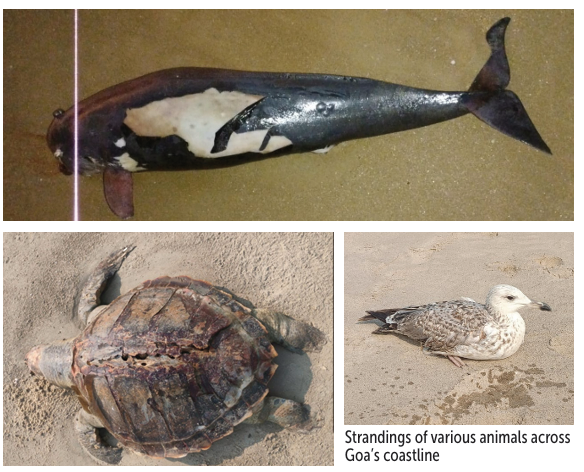
Multiple wildlife strandings reported along Goa’s coastline in the first fortnight of the New Year have once again unsettled conservationists, with the discovery of dead dolphins and sea turtles, alongside injured birds and reptiles, across beaches in both North and South Goa. Dead sea turtles were reported from Candolim in North Goa and from Varca, Talpona, Rajbagh, Patnem and Cavelos sim in the South. A Finless Porpoise was found dead at Velsao, adding to the tally of marine mammals lost this year. Other incidents during the same period involved a seabird discovered ground ed and unable to fly at Mandrem, and a snake found entangled in discarded fish ing netting at Polem. While some ani mals were rescued, several were already dead by the time they were spotted. Conservationists say the cluster ing of incidents within a short span of days has once again drawn attention to a pattern they say has been visible for several years, particularly during the early part of the year. While individu al strandings are responded to as they occur, they argue that the absence of a broader policy framework has meant underlying issues remain unaddressed. At the centre of their concern is the continued lack of publicly released post-mortem findings and consolidated cause-of-death data. Although the For est Department coordinates responses to wildlife strandings along the coast, no of ficial summaries ana lysing post-mortem results or identifying trends over time have been placed in the public domain, de spite years of reported incidents. Conservationists say this gap has direct consequences. Post-mortem findings, they argue, are essential not only to explain individual deaths, but to establish whether re peated strandings are linked by common factors.
Without verified cause-of-death information, they say it becomes difficult to move beyond rescue and recovery towards pre ventive measures that could reduce future losses. “This is where the system keeps breaking down,” said an environmentalist. “Animals wash up, they are recorded, and the immediate response happens. But without shar ing post-mortem findings, we are never able to answer the most basic question — why this keeps happening, year af ter year.” The recent incidents have also highlighted the range of species affected, extending beyond marine mammals and sea turtles to include birds and snakes. Conservationists say this points to a wider coastal wildlife management is sue, rather than an isolated marine problem, particularly as many of the incidents occur on open, public beaches. They note that beaches function as shared spaces used by tourists, fishers, lifeguards and local residents, yet there is little clarity on protocols for handling injured wildlife, managing discarded fishing gear, or dealing with deceased animals when strandings occur repeatedly across loca tions.

Without a comprehensive, data-backed policy, conserva tionists warn that responses risk remaining reactive rather than preventive. Transparent release of post-mortem find ings, they say, would allow patterns to be identified, inform management decisions, and enable meaningful public dis cussion on how to address the issue. As official post-mortem data on the recent deaths re mains awaited, conservationists say the strandings report ed in the first fortnight of the year serve as an early and un settling reminder that the problem has not abated with the turn of the calendar — and that without clarity on causes, the same questions will continue to surface with each new incident along Goa’s coast.